Trauma in Peacebuilding

About the project
Traditionally, peacebuilding programs in Palestine and Israel focused on structural and political aspects to address the national aspirations of Palestinians and Israelis. There is a need to recalibrate these approaches and strategies to address trauma and pain as integral components of any peacebuilding programs, underscoring the profound impact of unresolved trauma within Palestinian and Israeli societies and recognizing the scars left by violence, displacement, and loss.
A primary barrier to the operations of civil society peacebuilding is that both staff and beneficiaries have been (re-)traumatized since the Hamas attack on October 7 and the subsequent Israel-Gaza War. To this effect, psychosocial support to cope with the trauma, and skills to help their beneficiaries, have become prerequisites for NGOs to resume their operations. Demand from NGOs was captured in a January 2024 ALLMEP member NGOs' survey that found such trauma services for their staff and beneficiaries to be the highest priority, yet they lack the means to provide it.
The project will train 50 staff of peacebuilding organizations within ALLMEP's network, providing both trauma support for them and lessons on how to integrate psychosocial support int their programs. Pilot trainings on ALLMEP staff will work to inform this main part of the project. Meanwhile, the project will foster collaboration and exchange between Palestinian and Israeli communities to promote psychosocial support and mental health resilience. Finally, ALLMEP will advocate to governments, donors and other stakeholders to emphasize the importance of integrating psychosocial support into conflict resolution efforts, with the intention of encouraging investment in traumatherapy and peacebuilding programs that incorporate this approach.
What are our goals?
Goal 1: To integrate psychosocial support and trauma-informed approaches into member NGOs' organizational structures: team, programs and initiatives.
Goal 2: To foster collaboration and exchange between Palestinian and Israeli communities to promote psychosocial support and mental health resilience.
Goal 3: To spur governmental and philanthropic funders to set a standard for their grantees to integrate a trauma-informed approach into their programming, and to fund psychosocial support.
How does the project work?
Phase 1: Staff Training and Capacity Building (2 months)
Phase 2: Member NGOs Engagement in three cohorts: Palestinians, Palestinian citizens of Israel, Jewish-Israelis; Training of Trainers (ToT), and Sharing of tools and resources on Platform (12 months)
Phase 3: Organize joint online seminars for Palestinian and Israeli peacebuilders; Facilitate dialogues and exchanges to share best practices (4 months)
In parallel (24 months): Monitoring and Evaluation; Communication and advocacy - Develop communication materials and case studies highlighting the impact of trauma-informed peacebuilding approaches on individuals and communities affected by the Israeli-Palestinian conflict. Engage with policymakers, donors, and other stakeholders to raise awareness about the need for investment in mental health and psychosocial support as integral components of sustainable peacebuilding.
Who organizes and supports the project?
The Alliance for Middle East Peace (ALLMEP) represents a network of over 160 organizations engaged in civil society peacebuilding between Israelis and Palestinians. We work in the region to raise the capacity, connectedness, and collective impact of our members toward our shared goal of peace and equality. Internationally, we are the prime interlocutor between Israeli/Palestinian civil society and governments around the world, with a track record of raising the profile of peacebuilding as a policy tool, as well as unlocking close to $400m in government funding for the field, most notably via the $250 million landmark 2020 Nita M. Lowey Middle East Partnership for Peace Act (MEPPA). ALLMEP’s global advocacy efforts maintain and grow government resources for Israeli/Palestinian civil society. Equally critical alongside ALLMEP’s advocacy strategy is its plan to raise the capacity of the peacebuilding field. ALLMEP provides its growing membership with broad, fieldwide support, as well as individual consultation, through its expanding member services portfolio.
-
Image
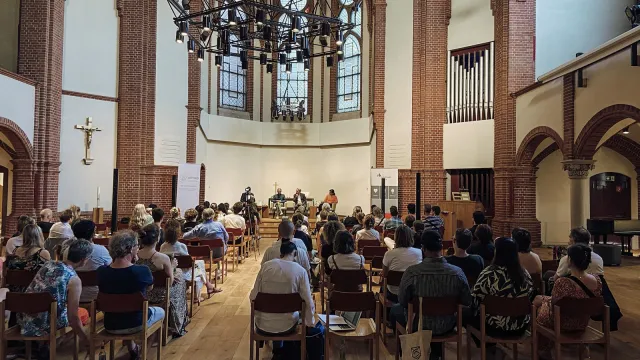
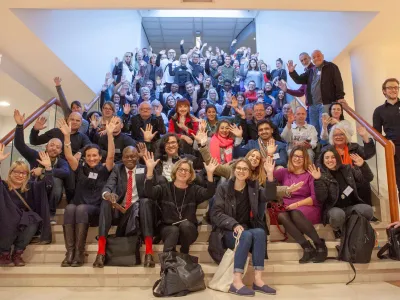
Am 27.06.24 luden die Alliance for Middle East Peace und die Robert Bosch Stiftung in Berlin zur Veranstaltung „How to Carry On: Civil Society Peacebuilding Amidst Trauma”. On June 27th, 2024, the Alliance for Middle East Peace and the Robert Bosch Stiftung hosted the event "How to Carry On: Civil Society Peacebuilding Amidst Trauma" in Berlin -
Image
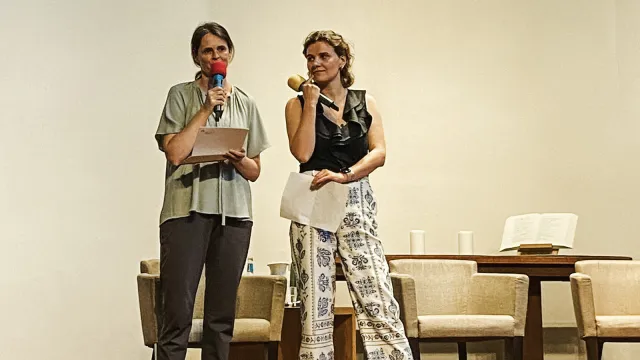
Luisa Siemens, ALLMEP European Outreach Director (links), und Irene Weinz, Senior Expertin der Robert Bosch Stiftung, begrüßten im Namen der beiden Organisationen und ordneten die Thematik ein. Luisa Siemens, ALLMEP European Outreach Director (left), and Irene Weinz, Senior Expert at the Robert Bosch Stiftung, welcomed the audience on behalf of the two organizations and introduced the topic. -
Image
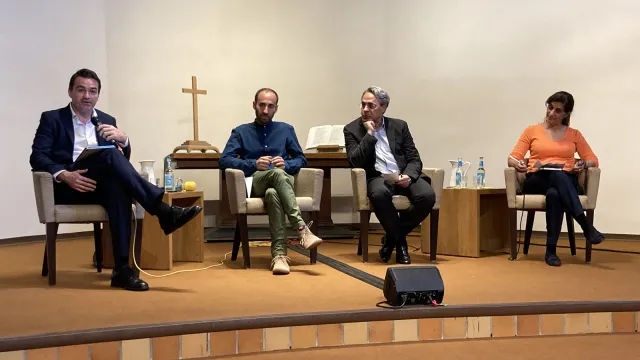
Moderiert von ALLMEP Executive Director John Lyndon, diskutierten der Friedensaktivist Yonatan Zeigen, der Neurowissenschaftler Dr. Ahmad Abu-Akel und die Peacebuilderin Sanam Naraghi Anderlini (von links nach rechts) den Einfluss von Traumata auf Konflikte und Peacebuilding am Beispiel des Konflikts in Israel und Palästina. Moderated by ALLMEP Executive Director John Lyndon, peace activist Yonatan Zeigen, neuroscientist Dr. Ahmad Abu-Akel, neuroscientist, and Sanam Naraghi Anderlini, peacebuilder, (from left to right) discussed the influence of trauma on conflicts and peacebuilding, based on the conflict in Israel and Palestine.
Trauma in Peacebuilding
Watch the video of our panel discussion: How To Carry On: Civil Society Peacebuilding Amidst Trauma
June 27, 2024, Berlin
News from the project
Your contacts
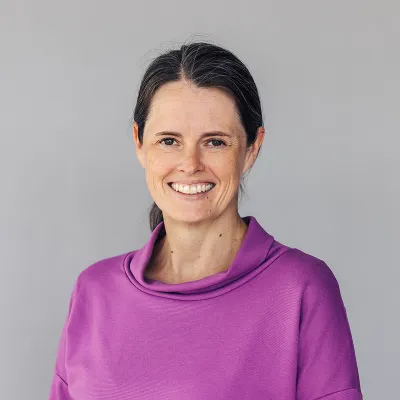
Irene Weinz
Senior Expert

![[DE Copy] Sport vernetzt_Teaser](/sites/default/files/styles/bosch_4d3_medium/public/images/media/2024-09/Teaser.jpg.webp?h=827069f2&itok=KlkCcg6z)
![[DE Copy] STaF_teaser 800x600](/sites/default/files/styles/bosch_4d3_medium/public/images/media/2023-07/Projektbild_STaF_%28c%29Unsplash_naassom-azevedo_quer.jpg.webp?h=827069f2&itok=USIttyra)