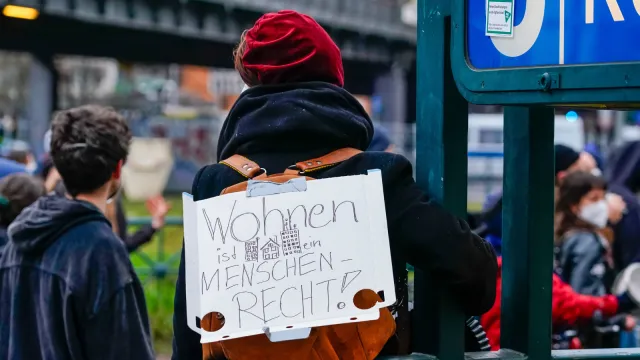
"Who can still afford that?" Words often heard today from those looking for a home. Rent prices in major German cities are rising rapidly, long-term residents are being pushed out of their neighborhoods, and new-build projects are increasingly designed for luxury. Those who already have an apartment are desperately holding on to it. The housing market is tough, a so-called "closed shop" to which many people no longer have access.
In Bremen, rent is now unaffordable for many people. The denkhausbremen organization has been campaigning for more justice on the housing market and affordable housing for over a decade. To this end, denkhausbremen brings together all stakeholders - from the homeless to politicians.
Reopening the doors to the housing market
"We want to act as a hinge and door opener between different players who share common themes, but otherwise don't have many points of contact with each other," explains denkhausbremen Managing Director Peter Gerhardt. "It's about ensuring that thinking, talking, and deciding about a socially just future is not just left to privileged people who are not, themselves, affected by issues such as unemployment or homelessness."
Contact across social boundaries is therefore crucial: "We bring those who are directly affected by this issue to the table with politicians, authorities, environmental protection organizations, and housing associations and engage in discussions on an equal footing." The denkhausbremen association also actively approaches politicians with demands relating to social justice; formulated at events such as the denkhaus Future Congress in June 2023 where the topic of housing was also on the agenda.
Housing shortage in the center of society
Homelessness in Germany has long been an existential issue, not only for the estimated 600,000 homeless (source: Bundesarbeitsgemeinschaft Wohnungslosenhilfe e.V.), some of whom live permanently on the streets, but also for people from the middle class. Representatives from all areas of society are therefore needed to help find ways to ease issues plaguing the housing market and enable everyone to participate.
"This is especially true where politicians in the municipalities, but also at the federal level, offer no solutions and are slow to fulfill promises for more new housing construction, if at all", says Joachim Barloschky, co-founder of the Human Right to Housing Action Alliance in Bremen and participant at denkhausbremen's 2023 congress. The action alliance is one of the organizations that denkhausbremen works closely with to campaign for social justice.
Bremen quarter gets a new look
A development in Bremen's Tenever quarter demonstrates the success and attention that campaign alliances can generally achieve. Built in 1970/71 as a "demonstration building project", the high-rise neighborhood was long regarded as precarious and isolated. Over 8,000 people from 90 nations lived here in a very small area, in partly run-down buildings and in unacceptable conditions. The residents no longer wanted to put up with this: They organized themselves, founded an initiative, drew attention to their situation with demonstrations and actions in front of Bremen City Hall, and did not allow the responsible authorities and politicians any respite. Soon the media were also reporting on the fight for a neighborhood worth living in, with success: Bremen-Tenever was extensively redeveloped over the years and property speculation was more strictly regulated.
The fact that Tenever is now perceived as a colorful showcase district is thanks to its courageous and determined residents. Similar stories can be told from many major German cities - and it was, and is, almost always citizen initiatives that have jump-started change. They can refer to Article 25 of the UN human rights treaty: “Everyone has the right to a standard of living adequate for the health and well-being of himself and of his family”. In addition to food and clothing, this also also includes housing.
What tenacity can achieve
There is now once again a higher proportion of socially subsidized apartments in Bremen, and for new buildings 30% are allocated to individuals with a certificate of eligibility for housing. "The state government has also decided not to sell properties to investors, but to hand them over for use on a 90-year leasehold basis. The city remains the owner and thus retains control," explains Joachim Barloschky. "However, this is only happening on a small scale. There is still room for improvement." The fact that anything has moved at all in terms of housing and property policy is thanks to his campaign alliance, which has made housing policy a top issue in the city with perseverance, constant new campaigns, demonstrations, encouraging discussion rounds, and lots of media coverage.
"Consistent, loud and well organised" - for denkhausbremen, this is a building block for the success of action alliances. Everyone can do something in their own city and in their own neighborhood.