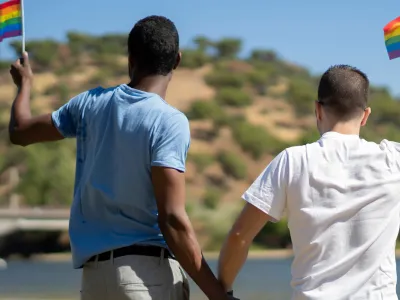
While a clear majority of people in Germany still accept queer individuals, acceptance of diverse sexual orientations and gender identities has dropped markedly in recent years. This is highlighted by the findings of the Robert Bosch Stiftung's representative Diversity Barometer study. In 2019, the “sexual orientation” dimension scored 77 out of 100 points; by 2025, that figure had fallen to just 69 points.
A particularly concerning trend is the sharp deterioration in attitudes towards transgender and non-binary people. While only 11 per cent of respondents in the first wave of the Diversity Barometer felt that transgender people should keep to themselves, that share had nearly doubled to 21 per cent by 2025. Likewise, 35 per cent of respondents in the latest survey agreed that changing one’s gender is “against nature”, compared with 23 per cent in 2019.
These developments coincided with years of public debate over Germany’s Self-Determination Act, which aimed to give transgender, intersex and non-binary people easier and more autonomous access to changing their legal gender marker and name. The debate was accompanied by a sharp rise in anti-trans rhetoric, which may help explain why acceptance of transgender and non-binary people has declined since 2019.
Attacks on Queer People Are on the Rise – Yet Political Protections Are Being Rolled Back
The growing hostility towards queer people—and transgender and non-binary people in particular—is reflected not only in attitudes but also in rising levels of violence and intimidation. In 2025, Germany officially recorded 2,084 anti-queer offences, a tenfold increase compared with 2010. While hate speech and verbal abuse remain widespread, physical assaults, threats and property damage are increasing most sharply. More than 70 Christopher Street Day (CSD) events across the country were disrupted or came under attack in 2025, often by far-right groups.
At a time when stronger protections are urgently needed, existing rights and safeguards for LGBTQIA+ people are increasingly coming under pressure. The “Living Queer” action plan, introduced by the coalition government in 2022, was discontinued early by the current federal government after the AfD had already called for its termination in 2024. Further proposals from the political right seek to curtail queer rights, including by repealing the Self-Determination Act and abolishing Germany’s General Equal Treatment Act.
At the same time, Bavaria and Baden-Württemberg have adopted regulations that allow personal data to be automatically shared with security authorities under the Self-Determination Act. Critics warn that this effectively forces some people to disclose their gender identity against their will, exposing them to stigma and discrimination. Although a similar federal regulation relating to registration records has so far been blocked, these developments are nevertheless fuelling uncertainty and anxiety within LGBTQIA+ communities. The Federal Anti-Discrimination Agency has accordingly reported a further rise in requests for counselling and support from transgender, intersex and non-binary people.
Politics and Civil Society Can Strengthen Queer Lives – If They Choose To
To ensure effective protection for queer people in Germany, it is essential that further measures from the Living Queer action plan are implemented. This includes amending Article 3 of the Basic Law to explicitly protect LGBTQIA+ people from discrimination, as well as reforming the General Equal Treatment Act and strengthening the Federal Anti-Discrimination Agency.
At the same time, rainbow families need greater legal certainty through reforms to parentage law, and transgender and non-binary people must have reliable access to appropriate healthcare.
Legal reforms alone, however, are not enough. Civil society organisations and initiatives working to promote awareness, strengthen democracy and counter extremism also need sustained support. Their work extends far beyond helping those directly affected: they provide training and guidance for educators, healthcare professionals, family members and public officials, helping to build understanding across society. As such, they play an indispensable role in fostering an open, diverse and inclusive democracy. Through both legislation and project funding, political decision-makers set important signals and exert a real influence on the equality and inclusion of LGBTQIA+ people.
Countering Anti-Queer Hostility Strengthens Social Cohesion and Democracy
The Diversity Barometer findings also show that attitudes towards sexual orientation are more polarised than those towards any other dimension of diversity examined in the study, including ethnicity, religion, disability and age. Those classified as “cosmopolitans”, who broadly embrace diversity, score 89 out of 100 points on the acceptance scale. Diversity sceptics, by contrast, score just 35 points, reflecting markedly lower levels of acceptance of queer people. The gap underscores how deeply anti-queer attitudes remain rooted among parts of the population.
Political leaders must therefore create the legal framework needed to curb this form of group-based hostility. At the same time, civil society itself has a vital role to play in standing up for queer people and building broad alliances against all forms of group-targeted discrimination and prejudice. Only by working together can we prevent further divisions within society. And only then can we fulfil the promise of a liberal society and a resilient democracy in which everyone can participate as equals — both in law and in everyday life.
About the authors
Ferdinand Mirbach is a Senior Expert on democracy and the Diversity Officer at the Robert Bosch Stiftung.
Chantal Müller is a Project Officer at LSVD⁺ – Verband Queere Vielfalt, one of the Robert Bosch Stiftung’s project partners.