Robert Bosch

Biography
The entrepreneur
From the beginning, Bosch was particularly concerned with the training and development of his employees. Deeply aware of his social responsibility, the entrepreneur was one of the first in Germany to introduce an eight-hour workday as early as 1906. Further exemplary social benefits for employees followed.
In 1937, Robert Bosch converted the stock corporation into a limited liability company (GmbH). This aimed to prevent outside influence on the company and to preserve its independence.
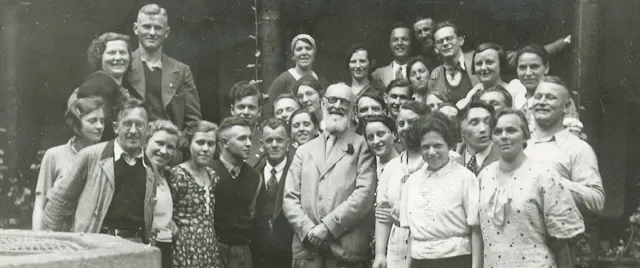
The liberal democrat
From early on, Bosch used the company's growing profits to foster social responsibility.
He donated most of the profits earned in the armaments business during the First World War to charitable causes. At the end of the war, he chose to play an active role in building Germany's first democracy. He supported the "German League for the League of Nations" and became a founding member of the "League for the Renewal of the Reich," which aimed to stabilize the republic on the basis of the Weimar constitution.
At the center of his European political commitment was Franco-German reconciliation, which he promoted in many ways, both financially and though personal initiatives.
Bosch saw reconciliation with France as the key to lasting peace in Europe.
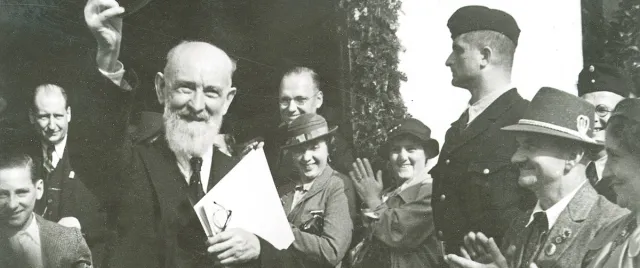
The committed citizen and benefactor
Company and Foundation: A twofold legacy
Robert Bosch and politics
Learn more about Robert Bosch's work and social engagement between 1920 and 1941.
The most important foundations and endowments
1910 – Stuttgart University of Applied Sciences
Robert Bosch donates 1 million marks to Stuttgart University of Applied Sciences.
1914 - Help in times of war
Robert Bosch donates 100,000 marks to the city of Stuttgart for World War I relief. Bosch sets up "Kriegshilfe von Handel und Industrie", a trade and industry-led war aid project with a fund of 300,000 marks and establishes a war hospital in Bosch factory buildings.
1915 - Homöopathisches Krankenhaus GmbH and creating social housing
Robert Bosch founds "Homöopathisches Krankenhaus GmbH", a homeopathic hospital, with a donation of 400,000 marks. The "Schwäbische Siedlungsverein e.V.", a housing association, is awarded 1 million marks to create sanitary social housing.
1916 - 20 million marks for charitable purposes
Robert Bosch donates around 20 million marks for charitable purposes, including 13 million marks for the construction of the Neckar Canal. The interest from the Stiftung Neckarkanal, the foundation established for the project, is donated to the city of Stuttgart to alleviate social deprivation. An association for the advancement of gifted children receives 2 million marks, and the "Verein Homöopathisches Krankenhaus", a homeopathic hospital association, receives 2.4 million marks for the construction of a hospital.
1917 - Haus der Freundschaft and Hochschule für Politik
The "Haus der Freundschaft" (House of Friendship) in Istanbul, Turkey, is built with the help of a donation from Robert Bosch. The "Hochschule für Politik", an educational project for a university of political science inspired by Friedrich Naumann, receives financial support.
1918 - Donation, funding, and scholarships
Robert Bosch donates 300,000 marks to the "Deutsche Liga für den Völkerbund" (German Federation for the League of Nations) founded by Matthias Erzberger. Bosch contributes 50 percent of the funding to establish the "Verein zur Förderung der Volksbildung" (Association for the Advancement of Adult Education), which will later become the German adult education movement. Esslingen Mechanical Engineering College receives 250,000 marks for an extension, and the Arts and Crafts School is granted 80,000 marks for the award of scholarships.
1920 - Social benefits for Bosch employees
From 1920 onwards, Robert Bosch introduces a range of social benefits for Bosch employees and their families.
1931 - Emergency aid in Württemberg
Robert Bosch donates 200,000 marks to the "Zentralleitung für Wohltätigkeit" (Central Administration for Charitable Work) for emergency aid in Württemberg.
1932 - Advancement of gifted children
After the death of Karl E. Markel, Bosch grants an endowment to the foundation established in his name for the advancement of gifted children.
1936 - Building a homeopathic hospital, resistance, and research support
The "Robert Bosch Krankenhaus Stiftung", a hospital foundation, receives 5.5 million marks to build a homeopathic hospital in Stuttgart. The same year marks the start of support for Jewish charities through the "Walz-Hilfe" organization. Financial aid is also given to the "Deutsche Freiheits-, Widerstands- und Erneuerungsbewegung" (German Movement for Freedom, Resistance and Renewal). Bosch establishes the "Sonderkonto Forschungs- und Studienhilfe", a special fund providing financial support for research and education.
1938 - Jüdischen Mittelstelle and employment of persecuted Jews
Between 1938 and 1940, Hans Walz donates substantial sums to Karl Adler of the "Jüdische Mittelstelle", an organization in Stuttgart that helps Jews emigrate from fascist Germany. The Bosch factories provide refuge to victims of racist and political persecution by the National Socialists.
1940 - Robert-Bosch-Krankenhaus
On April 28, Robert Bosch officially opens the Robert-Bosch-Krankenhaus in Stuttgart.
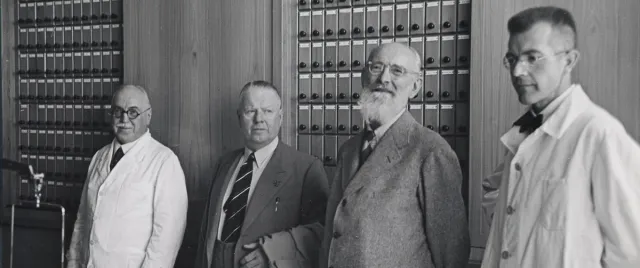
Will and mandate
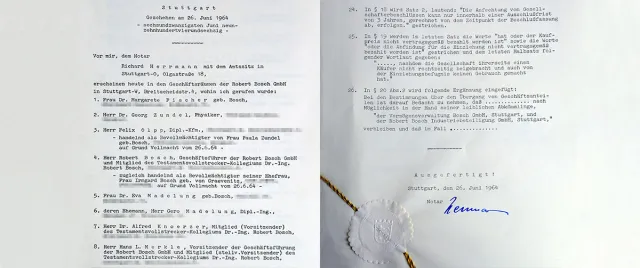
FAQs
Who owns Bosch?
The Robert Bosch Stiftung GmbH holds around 94 percent of the shares in the Bosch company, Robert Bosch GmbH. The remaining shares are held by a Bosch family company and the Bosch company itself. As a non-profit organization, the Robert Bosch Stiftung does not have any business activities. It has transferred the voting rights of its shares to Robert Bosch Industrietreuhand KG.
Who owns the Robert Bosch Stiftung?
The Robert Bosch Stiftung is an independent institution. It holds the majority of the shares in Robert Bosch GmbH and is financed by its dividends. Decisions on charitable activities and the use of the Foundation's funds are made by the Board of Trustees, whose members are also shareholders of the Foundation. In compliance with the wishes of Robert Bosch, the Board of Trustees includes members of the Bosch family, businesspeople, and public figures.
Who owns the Robert Bosch Hospital?
The Robert Bosch Hospital is owned by the non-profit Robert Bosch Stiftung. The hospital, located in Stuttgart, is part of the Foundation’s Bosch Health Campus. The Campus draws together all of the Foundation's activities and institutions in the field of health care: patient care, biomedical research, medical and nursing education and training, and the promotion and testing of promising new ideas for better health care.