Strengthening local civil society in Ukraine
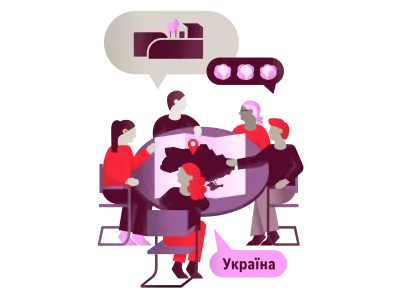
We empower Ukrainian civil society to actively shape the country’s reconstruction and future.
In Brief
- Through our work in Ukraine, we are strengthening Ukrainian civil society, which plays a crucial role in the country’s reconstruction and must thus be involved in decisions that shape its future.
- We work locally in long-term partnership with civil society organizations in Ukraine.
- We advocate for stronger international philanthropic engagement in support of Ukraine.
Insights





![[DE Copy] Panel der Robert Bosch Stiftung auf der Münchner Sicherheitskonferenz 2025 800x600](/sites/default/files/styles/bosch_4d3_medium/public/images/media/2025-02/Header-MSC-Artikel-Karl-Josef%20Hildenbrand-800x600_0.jpg.webp?h=accb7969&itok=OWO8NNhM)


![[DE Copy] Literaturforen Meridian_470x577](/sites/default/files/styles/bosch_4d3_medium/public/images/media/2024-09/Key%20visual_470x577.jpg.webp?h=35c5d4cc&itok=1OqzCjEJ)


![[DE Copy] Europe Prykhystok 470](/sites/default/files/styles/bosch_4d3_medium/public/images/media/2022-11/Europe_Prykhystok_Projektseite_470.jpg.webp?h=35c5d4cc&itok=RaH3h8t3)
The Challenge and Our Approach
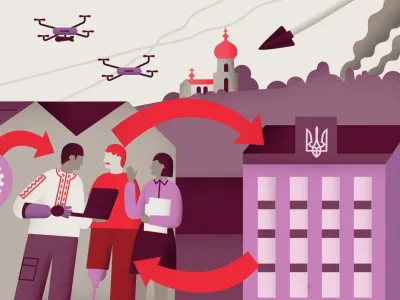
In its full-scale war of aggression against Ukraine, Russia systematically targets civilian infrastructure. As a result, reconstruction involves more than just rebuilding what has been destroyed, it also requires renewal in all areas of society (“Build Back Better”). Civil society plays a key role in this process but is frequently underrepresented in international discussions about Ukrainian reconstruction.
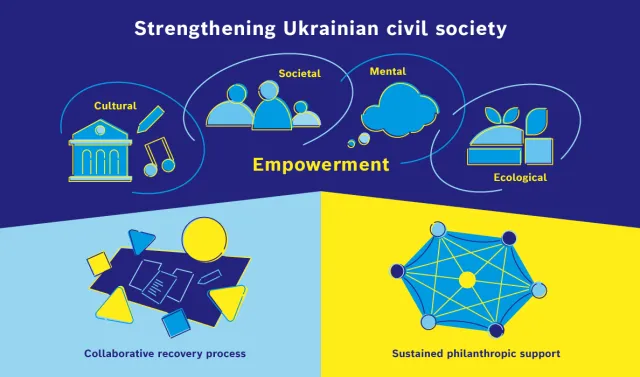
Our aim at the Robert Bosch Stiftung is to empower Ukrainians to shape the future of their country themselves. That is why we are strengthening the resilience of civil society actors in Ukraine – both during and after the war. We work in four main areas and their intersections:
- Sustaining cultural identity (cultural dimension)
- Strengthening societal participation in decision-making processes (societal dimension)
- Supporting mental health in light of the burdens of war (mental dimension)
- Advancing socio-ecological transformation (ecological dimension)
We also work to expand international philanthropic investment in Ukraine and ensure that funding directly reaches Ukrainian civil society.
Insights: Supporting Ukraine

FAQ
Brief answers to frequently asked questions on Ukraine.
How much will reconstruction cost?
According to the Rapid Damage and Needs Assessment published by the World Bank, the United Nations, the European Commission, and the Ukrainian government in February 2026, reconstruction will cost around USD 588 billion until 2036, about three times Ukraine’s GDP.
The study also makes the following estimates:
- Direct war damage: about USD 195 billion
- Total losses (including economic losses): about USD 667 billion
Actual costs will depend on the course of the war, economic developments and political decisions.
The goal is to not only repair the damage, but also to drive a modern, resilient and sustainable reconstruction (“Build Back Better”). Major investment needs include infrastructure, energy, housing, debris removal and demining.
How will Ukraine’s reconstruction be financed?
Funding comes from multiple sources:
- The EU, primarily through the “Ukraine Facility” (EUR 50 billion until 2027)
- The G7 countries
- International financial institutions such as the World Bank, IMF, and European Bank for Reconstruction and Development
- Frozen Russian assets, although their use remains politically and legally contested
In addition, the private sector and the engagement of companies is especially important in the areas of energy, housing and industry.
Reconstruction is a shared European responsibility, one in which foundations also play a role. The Robert Bosch Stiftung feels a special sense of responsibility, as we have maintained close partnerships with people and organizations in Ukraine for more than 30 years. As a European foundation, we allocated additional funds for emergency aid in Ukraine and its neighboring countries in response to Russia’s war of aggression in 2022 and 2023.
In 2024, we institutionalized our commitment through a dedicated funding area with an explicit focus on Ukrainian civil society.
What does “Build Back Better” mean?
The phrase “Build Back Better” refers to a holistic approach to rebuilding Ukraine after the war. The aim is not only to restore what was lost, but to also make the country economically, institutionally and socially stronger and more sustainable. This approach requires substantial investment over many years and provides a framework for international engagement and long-term support from partners such as the European Commission and the EU.
This requires:
- Modern and inclusive infrastructure
- A stronger and more competitive economy
- Stable democratic institutions and reforms
- Greater resilience to future crises
- Renewing public services like education and healthcare
- Enhancing civic participation
The Robert Bosch Stiftung’s primary goal is to strengthen Ukrainian civil society – its structures, professional capacities and the psychological wellbeing – so that it can actively shape the country’s future in a self-determined way. We support people and initiatives that are courageously driving recovery and reconstruction in innovative and locally grounded ways.
We also work to ensure that civil society is recognized and included as a key player by stakeholders in the reconstruction process – that is, by the government in Ukraine itself, and by partner countries, supranational organizations and international economic actors.
What does “green reconstruction” mean for Ukraine?
“Green reconstruction” is a central part of “Build Back Better” and focuses on sustainable transformation. Its priorities include:
- Renewable energy,
- energy-efficient housing,
- climate-friendly infrastructure.
The goal is to make Ukraine’s economy more sustainable, reduce its energy dependence and bring it into line with EU climate standards. This will require major investment and create opportunities for companies and the private sector to engage on economically sustainable terms.
We at the Robert Bosch Stiftung support Ukraine’s socio-ecological transformation as part of the “ecological dimension” of our funding strategy.
What is the EU planning for Ukraine’s reconstruction?
The European Union has made the reconstruction of Ukraine a long-term strategic priority and is supporting this effort through major funding instruments such as the Ukraine Facility, in coordination with international partners.
As the war continues and initial emergency support has already largely come to an end, it is becoming increasingly important for governments, EU institutions, and philanthropic actors to coordinate their efforts. Cooperation between foundations is also gaining relevance as a result. Given our longstanding ties to Ukraine, we at the Robert Bosch Stiftung feel a special responsibility to advance philanthropic efforts in the country.
Together with the Charles Stewart Mott Foundation, we have launched Foundations for Ukraine, a network of philanthropic organizations supporting Ukraine. It aims to strengthen cooperation among foundations, for example by:
- improving coordination in advocating for Ukraine
- enabling shared learning and understanding of evolving conditions
- better aligning philanthropic efforts to support local partners.
Foundations for Ukraine is not a fundraising platform, but a coordination and strategy network. Effective reconstruction depends on close cooperation between governments, business and civil society funders.
Publications

Your Contact

Julia Teek
Senior Project Manager