Well-Being from a Child's Perspective
About the Project
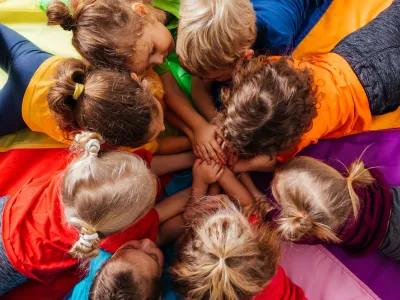
The Lower Saxony Institute for Early Childhood Education and Development (Niedersächsische Institut für frühkindliche Bildung und Entwicklung e.V., nifbe) is investigating what contributes to children's well-being in childcare centers – specifically from the children's own perspective. This approach places children's agency at the center and views them as independent and competent actors in their own lived environment. Until now, children's well-being has often been described and assessed by adults. This is where the research project comes in, asking: In which situations, at which locations, and under what conditions do children experience well-being in daycare? And what is particularly important to them in this regard? Methodologically, the project builds on the child‑perspective approach developed by the Institute for Democratic Development and Social Integration (DESI). Combined with a multimethod approach, children are actively involved in the research process—they take photographs, tell stories, create, and reflect together with the researchers. This creates a multi-layered picture of their experiences and perspectives. The goal is to identify key situations for children's well-being and derive concrete insights for educational practice. In a subsequent transfer phase, materials and training concepts will be developed to support educational professionals in specifically promoting children's well-being in everyday daycare life. The project is funded by the Robert Bosch Stiftung.
Why Do we Support the Project?
Children's well-being is a fundamental prerequisite for successful developmental and educational processes. Nevertheless, in research and practice it has often been defined and evaluated from an adult perspective. While many existing studies rely on objective living conditions or parental assessments, the perspective of the children themselves often remains unconsidered. The Convention on the Rights of the Child strengthened children's right to participation and the recognition of their own viewpoints – including in early childhood education. This project embraces this paradigm shift by giving children themselves a voice and thus enabling new insights into their subjective well-being. The project makes an important contribution to understanding well-being as a central dimension of educational quality and promoting corresponding conditions in daycare centers.
What is the Goal?
The goal of the project is to gain scientifically grounded insights into children's well-being from the children's own perspective. It aims to make visible in which situations, under what conditions and structures children experience well-being in daycare. Furthermore, professional staff and administrators should be sensitized to this issue and enabled to deliberately create supportive conditions. The research findings should demonstrate how educational situations must be designed to strengthen children, promote self-efficacy, and support their mental health. In the long term, the project should contribute to anchoring well-being as a guiding principle in early childhood educational practice and incorporating it into professional development processes.
How Does the Project Work?
In ten childcare centers, children will be interviewed using various qualitative methods. Creative, visual, and language-based approaches will be employed, adapted to the individual forms of expression of the children. In a pilot phase, suitable data collection instruments will be selected, tested, and subsequently refined. The goal is to combine three to four data collection methods to make the diversity of children's perspectives visible. The collected data will be analyzed using the documentary method to reconstruct typical patterns and key situations of well-being. Based on these results, practice implications will be derived that show how educational professionals can specifically promote well-being in everyday situations. In a subsequent transfer phase, the development of materials and training concepts is planned, which will be tested in practice.
More Information
Learn more about the child‑perspective approach of the Institute for Democratic Development and Social Integration (DESI)
Your contacts
![[DE Copy] Nina-Sofia Schmidt_Profilbild](/sites/default/files/styles/bosch_square_medium/public/images/media/2023-07/Schmidt_Nina-Sofia_03.png.webp?h=f6c0c716&itok=OHPkd0qT)
Nina-Sofia Schmidt
Senior Project Manager

![[DE Copy] Sport vernetzt_Teaser](/sites/default/files/styles/bosch_4d3_medium/public/images/media/2024-09/Teaser.jpg.webp?h=827069f2&itok=KlkCcg6z)