
Schools are an important part of the lives of children and young people. Not only are they places of learning, they also play a crucial role in the mental and spiritual health of students. Children and adolescents need to feel comfortable at school in order to learn successfully. It is therefore surprising that there is so little research on the relationship between school and mental health.
The Robert Bosch Stiftung is filling this gap with the German School Barometer for Students. In collaboration with the University of Leipzig, we surveyed children, adolescents, and their parents for the first time, rather than teachers and school administrators. We were particularly interested in how children and adolescents assess their own mental health, how they rate their quality of life, and what influence school has on their well-being.
8000
On average, children and young people in Germany spend hours of their lives at school
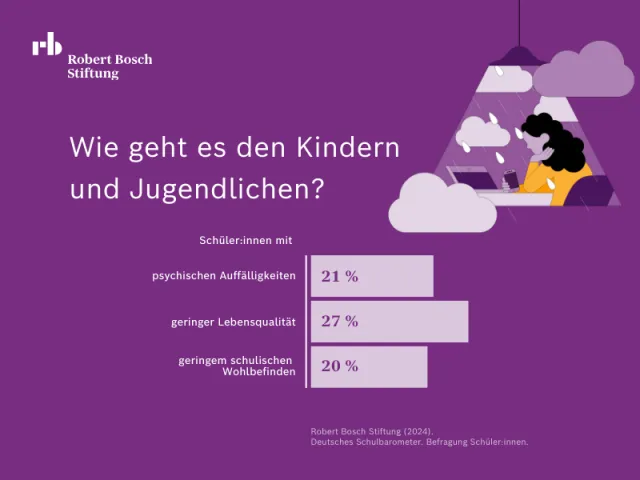
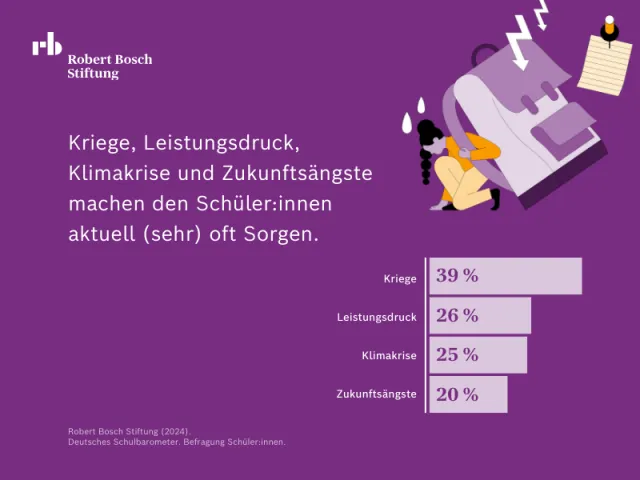
The results are alarming: the mental health and well-being of children and adolescents is still well below levels seen before the coronavirus pandemic. A quarter of young people rate their own quality of life as low. Two-thirds rate it as medium, and only six percent rate it as high. About one-fifth of students describe themselves as mentally stressed. A similar number complain of low well-being at school, and among children from low-income families, nearly one in three feels this way. The world's wars, the pressure to perform at school, the global climate crisis and fears about their own future are what worry them most.
Criticism of teaching quality: students lack individual feedback and support from teachers
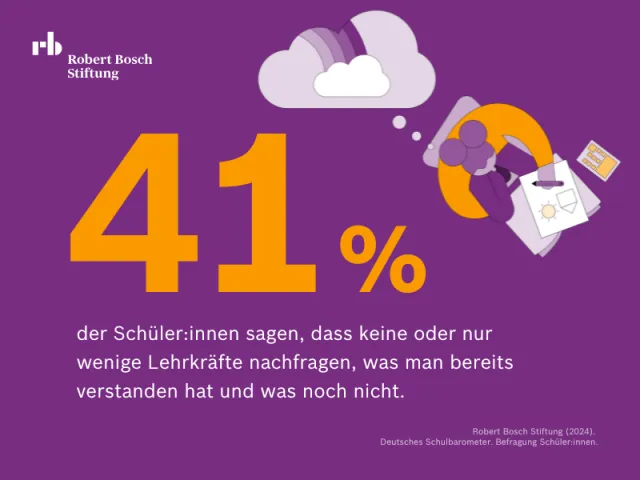
The results show that students' well-being at school depends primarily on how much they are supported by their teachers. Students who feel emotionally and intellectually supported and guided in their learning by their teachers are more satisfied with school overall. Students clearly state that they would like more guidance in the classroom and better quality teaching. Yet more than one-third of students never or less than once a month have a class period where they can talk to the teacher about problems and other classroom issues. The study shows that there is a link between the well-being of children and young people at school and this opportunity for discussion.

“We need a new understanding of teaching that puts the learning process at the center. In addition to data-based diagnostics, this also requires alternative exam formats and times in order to establish individual learning development as a new standard.”
Some parents receive no help for their children's mental health problems
The study also sheds light on how parents deal with mental health and what support services they use for their child. The study found that up to one-third of parents are unaware of the support services available at their child's school. When they do seek help from the school, they tend to contact their child's teacher first. However, a quarter of parents who approached the school did not receive any help. Alarmingly, children and adolescents wait an average of five months to begin treatment.
Recommendations for action: What do the results imply?
The German School Barometer for students was created by the Robert Bosch Stiftung in collaboration with Julian Schmitz from the University of Leipzig and a research team from various departments. Based on the results, the experts are deriving recommendations for action that focus on three points:
- Increasing well-being at school: implementing constructive feedback in the classroom
- Thinking of school in the social space: expanding care structures inside and outside of school
- Building a positive classroom climate: strengthening the quality of relationships and the climate for discussion
Schools should focus more on the well-being of children and young people, according to the experts. They recommend involving students in all decisions concerning school life on an equal footing in order to achieve a positive tipping point towards a democratic school.
You can read the detailed recommendations for action in the research report.