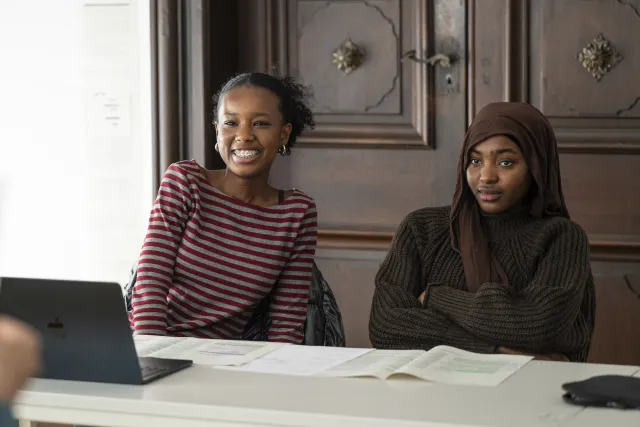
Diariou is lost in thought. Laptop open, she absentmindedly toys with a ballpoint pen, her eyes scanning the results of a Google search for “Syrian crisis 2020,” the cover of the textbook next to her proclaiming the words “Global Politics” in a bold blue. The desks in the classroom have been arranged in a U-shape, a setup which usually sparks some good debate among the students. Today, however, group work is on the agenda. The 15 students all sit at their laptops, tasked with applying a theoretical model for conflict resolution to different countries.
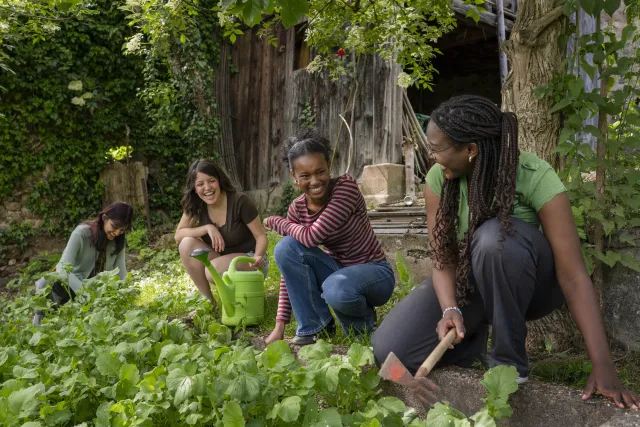
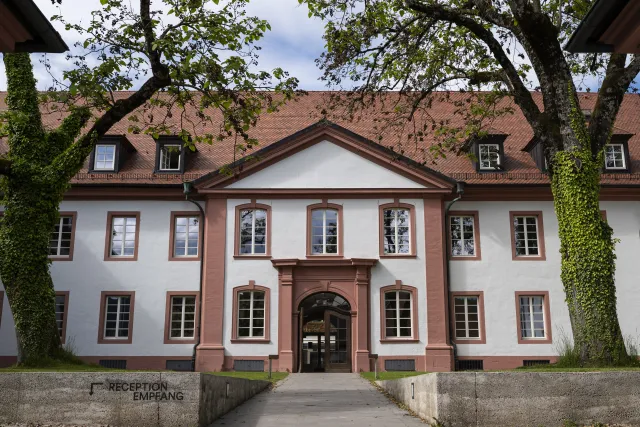
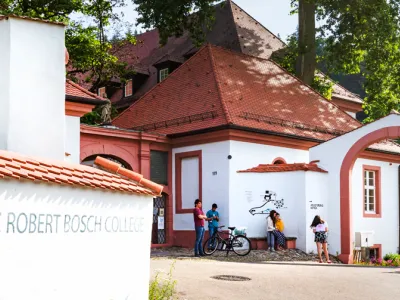
Diariou, who is originally from Belgium, has been attending UWC Robert Bosch College in Freiburg for the past year now. The private boarding school for children aged 16–19 prepares young people from all over the world to sit their international diploma over a two-year period. The curriculum also actively incorporates both peace and sustainability – in regular classes as well as through extracurricular projects like in the school garden.
Just then, a teenage boy opens the door to the classroom and pokes his head round: “Is there an HDMI cable in here?” The students look up from their laptops and one of them gives a brief shrug. “No idea. Ask the IT guy.” The answer makes Diariou sit up straight, her gaze suddenly fixed intently on the other people in the room. Because that “IT guy” will have a name, and his own life story too.
Learning and living side by side helps build awareness of diversity
Such awareness of diversity in lived experience is one of the school’s central pillars and something it aims to instill in all its students. The 200 or so students here come from 90 different countries, and almost all of them are on full or partial scholarships at a school where applicants’ financial background is not supposed to factor in whether or not they are offered one of the 100 yearly places at the college.
The students’ life stories and cultural backgrounds are therefore just as diverse. “By living and learning side by side, our young people gain a broader awareness of diversity and how to respect each other’s way of life,” explains Helen White, who has led the college as its rector since 2024. “They understand that behind any political conflict there are always real people and real perspectives. Engaging with these perspectives, talking to one another, is how we can play a role in achieving long-term peace.”
Diariou too is well aware of just how much life at the Robert Bosch College continues to shape her views. “Before I joined, I went to a Catholic school in Belgium, and so much of what I thought, of the judgments I made, came only from the news,” she says. “As a result, I would form an opinion without ever speaking to the people who were actually affected by the problem.”
On campus in Freiburg, she now actively engages with all sorts of viewpoints. Here, students live and learn side by side around the clock, and of course this is not without its problems. “This is no utopia,” Helen White notes. “Our students are between 16 and 19 years old. It goes without saying that they push boundaries. We’re also no strangers to bringing together students whose personal backgrounds lead them to hold absolutely opposing views on international conflicts, causing them to clash.” Every year, White makes a speech to kick off the school year, where she makes it clear to the students that here on campus they do not represent their nationalities, but only themselves as individuals. “What they experience here is meant to show them that, at the end of the day, we all have more in common than what divides us.”
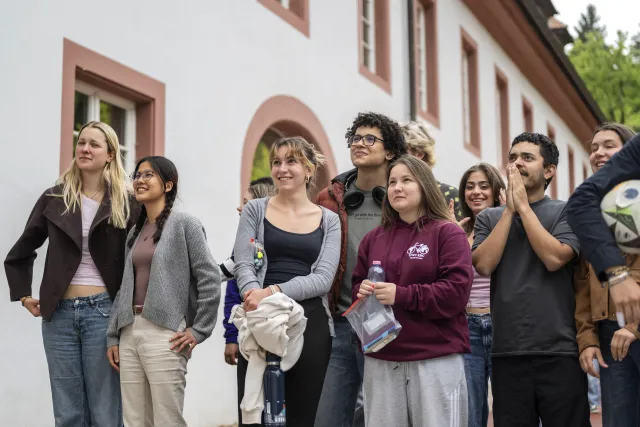
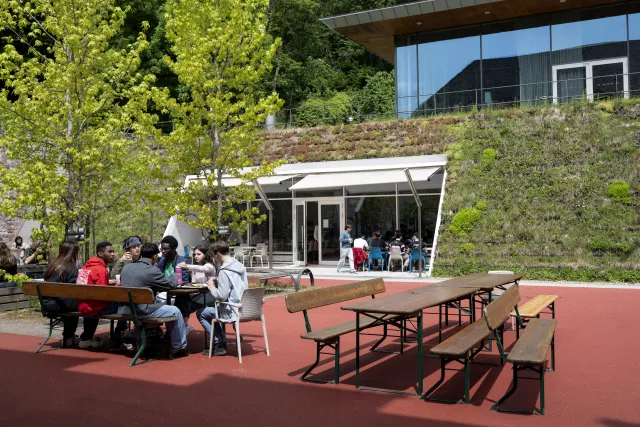
This sense of community is the very foundation of everyday life at the school. As Diariou sits out in the courtyard enjoying lunch with friends after class, a group of students gathers behind her – the seniors who will be taking their French exam in just a few minutes. When Diariou notices them, she and her friends jump up and run over to the group. A teacher calls the candidates up one by one and each enters the classroom to whooping and cheering from the remaining students.
Community in all areas of life: Students from four countries share one room
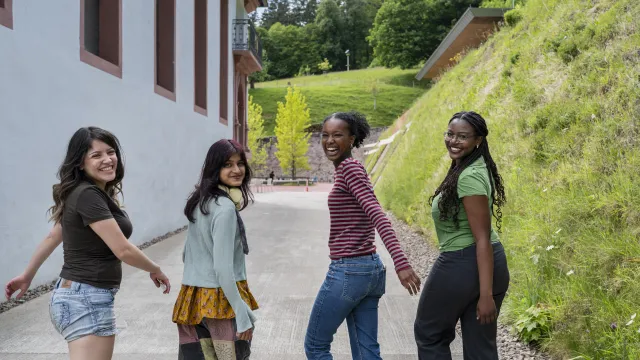
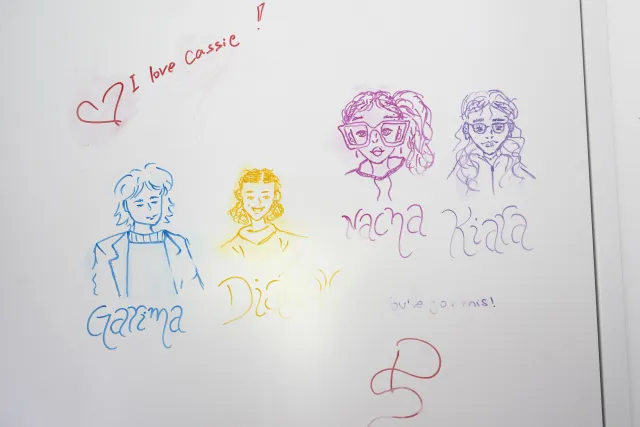
Diariou shares a room with three other young women: Kiara from Germany, Garima from Nepal, and Nacha from Chile. Back at the start of the school year, the four were strangers; now they’re as close as siblings. In their four-bed room in one of the school’s twelve boarding houses, their respective national flags hang alongside expressions of their distinct personalities in a joyful symbiosis of self-expression and compromise. While the four clubbed together to decorate their front door with affirmations and photos, each individual living space is personalized. Nacha’s side features a disco ball and pink garlands, while Kiara over at the other end of the room has crafted a vision board with the names of her favorite movies, bands, and self-penned poems. Diariou and Garima, meanwhile, share a space in the middle of the room, which they can separate with curtains. “The rooms can be tricky, because they don’t leave us with much space to get away from it all,” says Kiara. “But we’ve managed to communicate well and discuss our boundaries: When should lights out be? When should quiet time start? And if one of us needs to be alone for a bit, we just let the others know and we’re all happy to give space.”
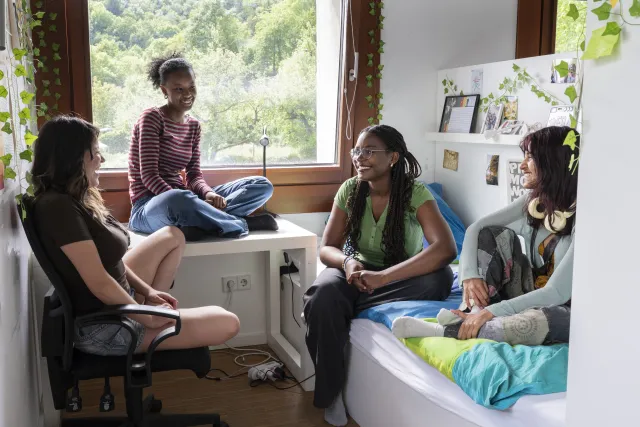
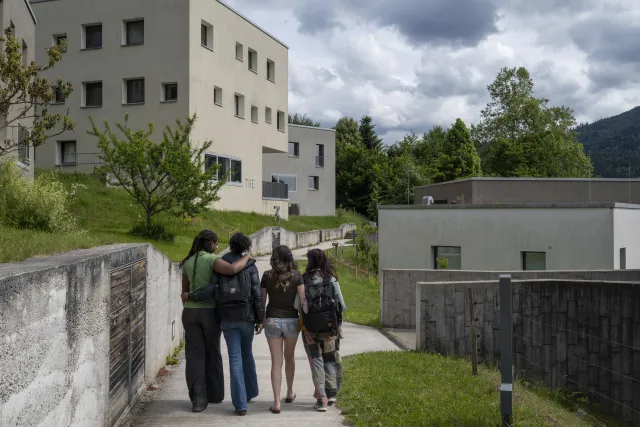
Life on campus is all about compromise and consideration for others. To make sure life at the boarding school runs smoothly, each boarding house has a house tutor and the house community meets once a week for a mandatory house meeting to go over rules or work through any conflict. But the house tutors are by no means the students’ only point of contact: the Robert Bosch College employs a network of psychological, medical, and nursing staff, as well as teachers, who are specifically responsible for individual students. In fact, the student-to-staff ratio is an incredible 1:8 – a figure most public schools could sadly only dream of.
From the school bubble to the real world: How to uphold the college’s values on the journey ahead?
Garima nods. “I’m well aware that I’m living in a bubble here,” she says one afternoon as she sits in the school’s sprawling garden. Around her, her roommates are busy feeding the college’s alpacas with a view of the vegetable beds tended by students and staff alike. “It’s easy to experience a kind of reverse culture shock when you realize that so much of what we take for granted here doesn’t work the same way outside the college grounds. But this place gives me hope that I can carry these values and this sense of mutual understanding out into the world with me.”
For many of the young people here, their two years at the college are the time when they find their voice. Diariou and Garima are hoping to study at university after graduation, while Kiara and Nacha are already one step further along the same journey – the two are nearing the end of their time in Freiburg. They have already packed up their belongings into boxes and are excited for their class’s big graduation party in just a few days. After that, it’s time to set off into the world.
They both have a clear plan for the journey ahead. Nacha is hoping to study computer science, while Kiara aims to become a doctor. Their time at the college has permanently altered both young women’s outlook on the future. “Back home, everyone wants to change the world, and I definitely had the same dream,” explains Nacha. “But over the past two years, I’ve learned that it also takes a ‘how’ and a ‘why’ to make that change happen. Here, I’ve found a network of people who are all outstanding in their own areas of interest and know that’s where they can make a difference. It’s given me such a positive outlook on the world, and in my own way I want to help more people feel the same.” Kiara nods. “I’ve learned here that change doesn’t have to be big. In the future, I want to talk to people and help them see that there are always multiple takes on any given problem.”

![[DE Copy] Robert Bosch Haus_UWC-Schüler_1200x900.jpg](/sites/default/files/styles/bosch_3d2_small/public/images/media/2024-04/Robert%20Bosch%20Haus_UWC-Sch%C3%BCler_1200x900.jpg.webp?h=b9151841&itok=URnqVe96)