Your contacts
Image
![[DE Copy] Sarah Müller_Profilbild](/sites/default/files/styles/bosch_square_medium/public/images/media/2023-07/Mueller_Sarah_02.png.webp?h=45202834&itok=VObbmh0r)
Sarah Müller
Projektmanagerin
Image
Talah Alshami
Syrbanism
this project
not empty related content
Sarah Müller
Projektmanagerin
Talah Alshami
Syrbanism
this project
not empty related content
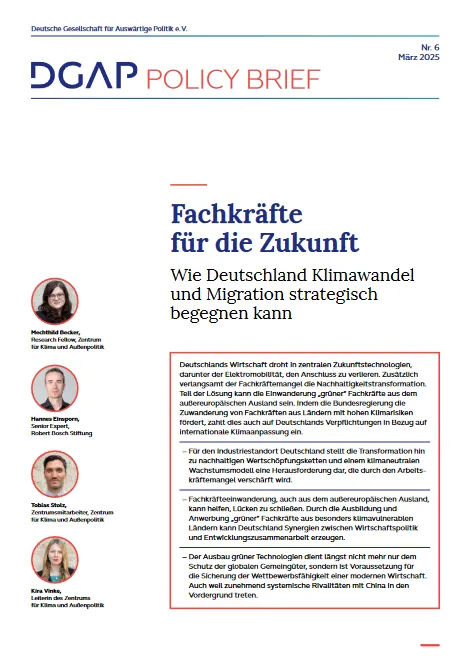
In view of the current shortage of skilled workers and the urgent challenges of climate change, the immigration of skilled workers with “green skills” from climate-vulnerable countries will be crucial over the next 20 years. In this brochure, our expert Hannes Einsporn and our partner the German Council on Foreign Relations (DGAP) describe concrete measures that the next German government can take to harness the potential of skilled labor immigration and shape a sustainable future for Germany and the countries of origin. In German language.
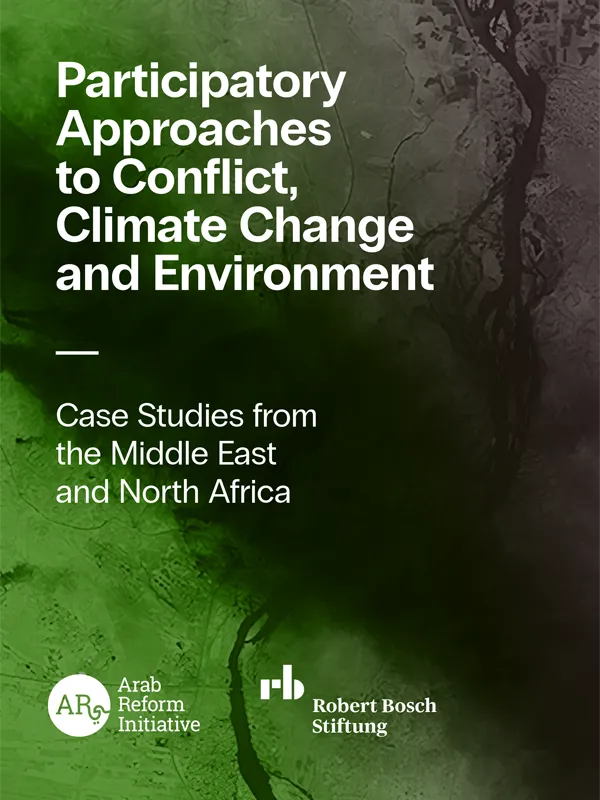
The Middle East and North Africa are one of the regions most affected by conflict worldwide. These conflicts result in massive environmental damage, while climate change and environmental degradation also give rise to new injustices and conflicts at the local level. Despite this, affected groups and stakeholders are often not involved in decision-making processes. This publication analyzes the implementation of participatory approaches in 7 countries in the region, particularly with regard to the potential for a better understanding of their implications for human security.
The dossier was produced in close collaboration with the Arab Reform Initiative.
Elisabeth van Gelder
Projektmanagerin

Florian Schmid
Naturpark Südschwarzwald
this project
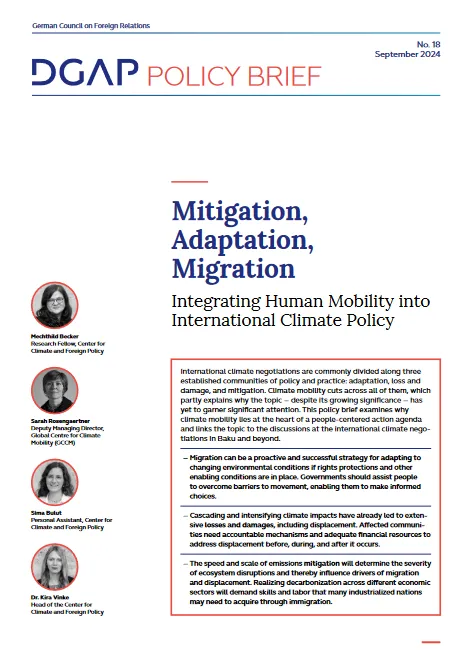
As international climate negotiations unfold, the conversation often focuses on three key areas: adaptation, loss and damage, and mitigation. However, one critical issue remains underexplored - climate mobility. This policy brief examines why climate mobility is essential to a people-centered action agenda and its relevance to discussions at the UNFCCC. It demonstrates how migration can serve as a proactive strategy to adapt to environmental change, provided that rights protections and enabling conditions are in place. The paper discusses why governments must facilitate movement and empower individuals to make informed choices, and the urgent need for accountable mechanisms and financial resources to support communities facing displacement due to escalating climate impacts. Finally, it considers the pace of emissions reductions and how this will affect ecosystem stability and influence migration drivers, highlighting the need for skilled labor through migration in the transition to a decarbonized economy.
![[DE Copy] Agora Agrar land use study](/sites/default/files/styles/bosch_original_medium/public/images/media/2024-09/AGR_Land-use-study_240903_Page_001_0.png.webp?itok=R0lJhWLv)
Approximately a third of all CO2 emissions come from our agricultural and food system. There is a lack of potential analyses and feasible future scenarios that take a holistic view on the land use sector. Our partner, the think tank Agora Agrar, is helping to fill this gap for the European Union with a new study.
Based on scientific evidence and numerous discussions with stakeholders from academia, politics, administration and the agriculture, forestry, food and bio-economy sectors, the Agora Agrar team presents a sound and solution-oriented scenario with concrete proposals for policy measures.
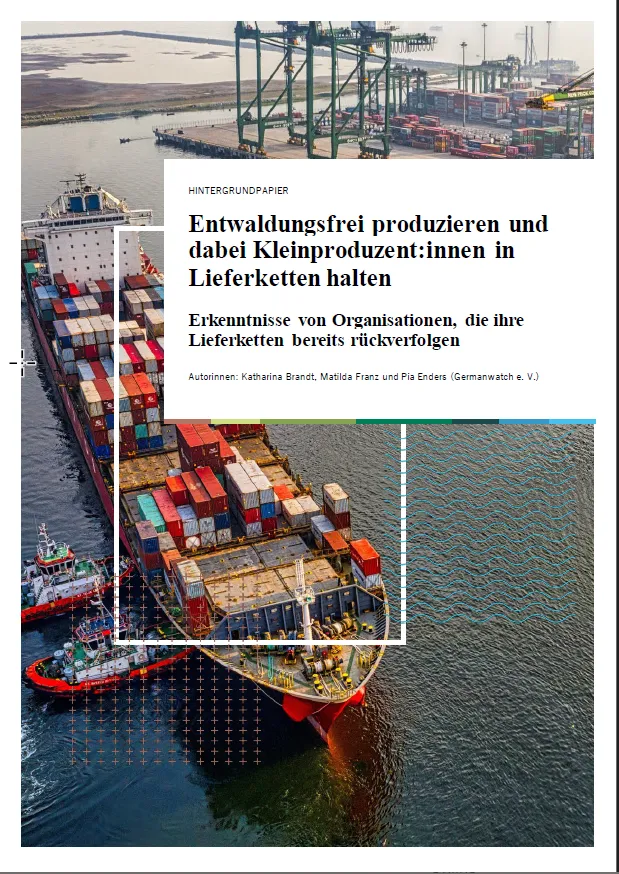
The EU regulation for deforestation-free products (EUDR) starting from December 30, 2024, has implications for small-scale producers in supply chains. In a new policy paper by Germanwatch e.V., Katharina Brandt, Matilda Franz, and Pia Enders provide recommendations on how the EU and companies can support small-scale producers to produce deforestation-free while ensuring their livelihoods. The focus is on implementing higher sustainability standards and traceability in supply chains to prevent deforestation and protect small-scale producers.
![[DE Copy] ecologic_Abschlussbericht_Cover](/sites/default/files/styles/bosch_original_medium/public/images/media/2024-06/CEE_agrifood_report_final_Page_001.jpg.webp?itok=zTozQVPk)
Agriculture in the EU is responsible for around 13% of greenhouse gas emissions. Agriculture and food consumption are the biggest contributors to biodiversity loss, environmental degradation and diet-related diseases. This report is intended to serve as an inspiration and framework for stakeholders in Central and Eastern European Countries (CEECs) to develop a more holistic and coordinated approach to the transition to climate-friendly and resilient agricultural and food systems.


![[DE Copy] 260502_IDMC_GRID26_web-1.jpg](/sites/default/files/styles/bosch_4d3_medium/public/images/media/2026-05/260502_IDMC_GRID26_web-1.jpg.webp?h=8c302e12&itok=Az0SHZfo)
![[DE Copy] Klimamitbestimmung_ cc Sarah Sakotic-Sondermann_800x600.png](/sites/default/files/styles/bosch_4d3_medium/public/images/media/2025-05/Klimamitbestimmung_%20cc%20Sarah%20Sakotic-Sondermann_800x600.png.webp?h=827069f2&itok=69K7dfNw)
![[DE Copy] Weaving_Lab_Projektseite_800x600](/sites/default/files/styles/bosch_4d3_medium/public/images/media/2023-12/Weaving_Lab_Projektseite_Antonio%20Garc%C3%ADa%20Guerrero%20800x600.jpg.webp?h=827069f2&itok=3d18Gte4)
![[DE Copy] Youth Negotiators Programme_Projektseite_800x600](/sites/default/files/styles/bosch_4d3_medium/public/images/media/2023-11/Youth%20Negotiators%20Academy_800x600.jpg.webp?h=827069f2&itok=jWspkrqW)
![[DE Copy] Marburg_Rural Gatherin_800x600](/sites/default/files/styles/bosch_4d3_medium/public/images/media/2023-11/03_BauernhofClemensGabriel_quer.jpg.webp?h=827069f2&itok=lQmJqRdO)
![[DE Copy] Zukunft_aufgetischt_800x600](/sites/default/files/styles/bosch_4d3_medium/public/images/media/2023-12/Zukunft_aufgetischt_800x600.png.webp?h=827069f2&itok=x3mOGabD)

![[DE Copy] GemeinsamVoran-Cover_210 x 297.png](/sites/default/files/styles/bosch_4d3_medium/public/images/media/2025-06/GemeinsamVoran-Cover_210%20x%20297.png.webp?h=6a9e38f6&itok=PSqKuGSE)
![[DE Copy] Climate-Landrights2025-cover.png](/sites/default/files/styles/bosch_4d3_medium/public/images/media/2025-05/Climate-Landrights2025-cover.png.webp?h=0a1a5052&itok=hrW8i-NA)