A further rise in temperature of 2 to 2.5 degrees
Climate change in the Middle East and North Africa (MENA) is a story of injustice. While the region has contributed a mere 3 percent of total global CO2 emissions since 1850, it will be hit extraordinarily hard by its effects.
Today, the MENA region is already hot and dry with 82.5 percent of its terrain covered in desert. 12 of the 17 world’s most water-stressed countries are located here. Even if emissions are cut according to the Paris Agreement, scientists predict a further rise in temperature of 2 to 2.5 degrees in the MENA region by 2039.
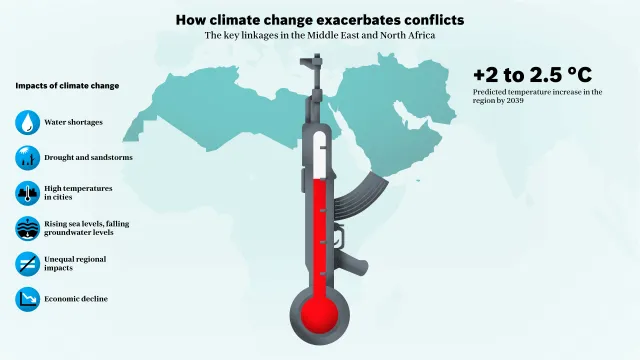
The link between environmental degradation and social and political problems became obvious with the Arab uprisings in 2011: in the five years prior to the uprisings, the region experienced one of its most severe drought cycles in 100 years, directly leading to loss of livelihood, high food prices and internal displacement. The most severely affected country was Syria, where 20 percent of the population lost their source of income, and which was subsequently engulfed in the bloodiest civil war the region had seen since the end of World War II.
On the other hand, conflicts in turn indirectly contribute to further climate change. This can be the case, for example, if necessary political measures are not taken or access to resources is made more difficult.
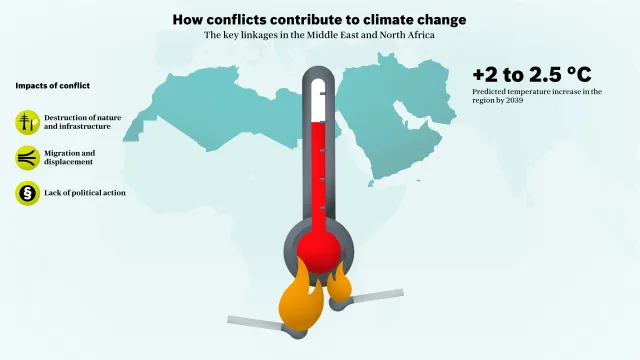
Supporting the Arab world in meeting the challenges posed by climate change will also be a matter of strategic importance for Europe: not only because unmanaged risks can lead to violent conflicts and displacement, but also because other geopolitical players are beginning to exploit the vulnerabilities of the region for their own purposes.




![[DE Copy] janineoswaldfotografie_RBS_final-800x600.jpg](/sites/default/files/styles/bosch_3d2_small/public/images/media/2026-05/janineoswaldfotografie_RBS_final-800x600.jpg.webp?h=827069f2&itok=RxPGzY-1)