In 2015, Feryal al-Naseem was 21 years old when the war came to her hometown of Aden in the south of Yemen. At the time, she was working for an initiative that organized cultural events: book clubs, concerts, themed evenings. She is actually a civil engineer. “I wanted to get involved in society, be a role model for young people, and show them perspectives other than the conflict.”
Al-Naseem was born into the conflict. In 1990, South Yemen and North Yemen united to form today’s republic. But the unity existed only on paper. In practice, the North Yemeni President Ali Abdullah Saleh imposed his rule on the south. The first civil war broke out just four years later.
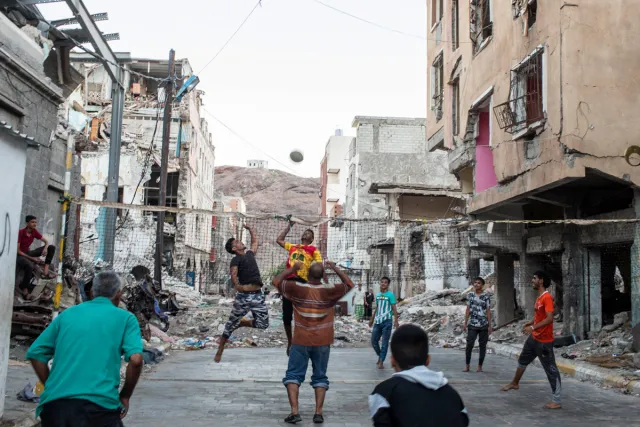
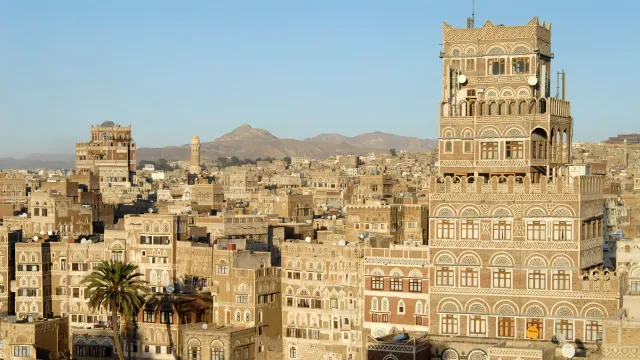
In 2014, Houthi group occupied the northern capital of Sana’a with soldiers loyal to Saleh, who had ceded power after the wave of Arab Spring protests hit Yemen in 2011. When these forces also invaded the southern city of Aden, the new seat of government, the southern movement was able to push them back after brutal fighting. “But the war changed the people,” says al-Naseem.
In Aden, a once cosmopolitan harbor city, radical voices grew louder in the aftermath of the war. During Friday sermons, cultural events were demonized as “haram” (forbidden). Above all, there was agitation against female employees.

“We women started covering our faces, my family stopped allowing me to go to work”
Even before the war plunged Yemen into one of the world’s worst humanitarian crises, women’s lives were already characterized by strict patriarchy and structural injustice. With the collapse of public institutions, the last protective walls for women also fell, while society clung ever more strongly to tradition and religion.
The founder of the cultural initiative that Feryal al-Naseem worked for was first threatened and then killed. “We women started covering our faces, my family stopped allowing me to go to work.” Al-Naseem sat at home reluctantly for a year and a half, before applying for a job as an assistant at the Aden office of the Sana’a Center for Strategic Studies. This time, her mother covered for her in front of her father and brothers – pretending that her daughter was now working for a humanitarian aid organization.
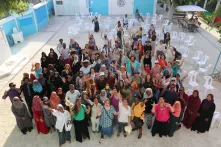
In addition to her work at the Aden office, al-Naseem soon took part in one of the Sana’a Center’s programs herself: the Yemen Peace Forum (YPF). This platform brings together young people from all regions of the country and actors from civil society to discuss current issues. The forum is supported by the Sana’a Center and funded by the Dutch Ministry of Foreign Affairs. The aim is to equip participants with the knowledge and self-confidence they need to influence their communities themselves. “I suddenly realized that my opinion counts. That I don’t want to leave the shaping of my future to others.”
Diversity creates self-confidence
Through the YPF meetings, Feryal al-Naseem got to know representatives from marginalized minorities, people with disabilities, and members of the Muhamasheen community, the most marginalized ethnic group in Yemen, popularly referred to as akhdam (slaves). She calls the platform, which she now manages as a coordinator, a “safe space.”
One of the topics being discussed at the forum is the education crisis, on which many of the teachers in Houthi-areas have not been paid a salary for years and have to take other jobs. “We are also currently considering how to deal with the militarization of curricula in the Houthi areas,” says al-Naseem.
The fact that most of the projects take place online is due not only to the restricted freedom of movement among the civilian population. “We can’t distribute flyers or put up posters. It’s too dangerous.” Across the entire country, local militias are clamping down on civil society. In the north of the country, the Houthis are terrorizing civilian organizations in the Houthi areas. Since 2017, Aden has been controlled by the “Southern Transitional Council” (STC), which is striving for independence for South Yemen but also uses its militias to control its own population. Events and meetings therefore have to take place abroad or sometimes in the somewhat quieter province of Hadhramaut, in the east.
Al-Naseem learned just how deep mistrust runs in the minds of her own society when she met her husband via social media – and he moved to Aden for her. “My husband is from Sana’a,” she explains. “He couldn’t even rent a flat in Aden because of his northern dialect. Everyone thought he was a Houthi.” As a result, the couple is currently trying to obtain a residence permit in Sweden.
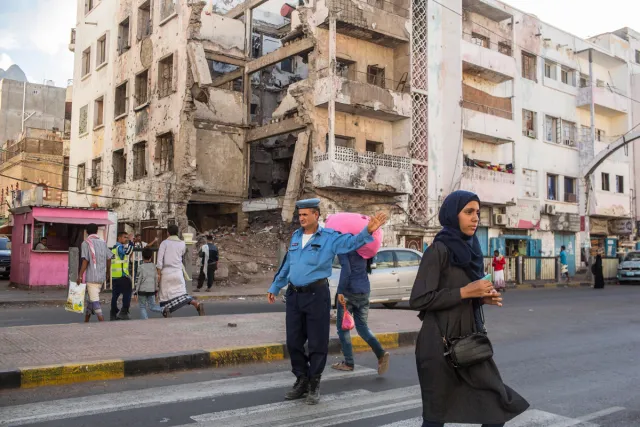
Her colleague Yazeed Al-Jeddawy has also sought refuge in Sweden and has lived there for two years and a half years. He coordinates the Sana’a Center’s research projects and publishes studies and articles. He believes, for example, that when it comes to one of the most pressing issues, namely inclusive peace work, transitional justice is about recognizing and coming to terms with the human rights violations committed by all parties to the conflict – so that the many victims can regain trust and participate in the peace process.
Al-Jeddawy himself comes from the mountain town of Ibb, which, like most of the north, is under the regime of the Houthi group. Shortly before the war, he was going to take up a university post in Saudi Arabia, but with the takeover of Sana’a by the Houthis came the closure of its embassy. Deeply concerned for his family and his country, he began working in educational programs for young people from Aden and other governorates and regained hope. “The enthusiasm with which they plan their future, despite everything, is inspiring.”
His first contact with the Sana’a Center was while working on a paper for the thinktank CARPO on the role of youth in peace-building in Yemen. His first publication for the Sana’a Center was about the impact of war on the priorities and needs of youth in Yemen. “I was inspired by the fact that Yemen’s most brilliant young people work tirelessly through research the true picture of the Yemen that younger generations aspire to live in.”
With their work, they want to counter the disinformation and propaganda put out by the parties involved in the conflict. “In Western media, it often seems as if Yemen’s youth is driving the war,” says Al-Jeddawy. But you have to realize that two thirds of the population live in rural regions, often scattered in tiny settlements. They lack everything there: water, electricity, and access to education. The Houthi group, in particular, is capitalizing on the isolation and poverty to recruit its soldiers – young people, often children – with promises.
Working for inclusive peace is fraught with danger
“Most young people have no interest in the war,” says Yazeed Al-Jeddawy. In fact, he is always amazed at how committed young Yemenis are to society. “When teachers across the country went on strike, the older students stepped in.”
Through the studies and articles that the Sana’a Center tirelessly sends out into the world in English and Arabic, the authors succeed in depicting the diversity of their complex country, amplifying local voices, analyzing the challenges of minorities and always putting women and young people center stage. For local projects, however, the first priority is to ensure the safety of anyone who participates.
“We have a very wide presence in Yemen,” says Al-Jeddawy. “But we take all the necessary measures to ensure the safety of everyone .” He had to experience for himself the dangers of openly campaigning for inclusive peace work. For years, he has been unable to visit his parents in the north of the country or bring his wife and two children from Aden to Sweden.
In 2022, Al-Jeddawy participated in the first Yemen International Forum, the largest and most inclusive platform for Yemeni-Yemeni peace dialogue organized by the Sana’a Center. At the conference first held in Stockholm, Yemenis from politics and the civilian sector were able, for the first time, to hold in-depth discussions about the prospects for a peaceful future. On the last day, he was advised not to return to Aden.
In 2019 he was also warned by a UN official not to go into Houthi areas. “The Houthis accuse almost everyone of being a Western spy,” says Al-Jeddawy. Some of his colleagues from other organizations have been kidnapped and tortured in the past. This summer, under a widespread campaign against civil society workers, the Houthis have attacked the UN office in Sana’a and detained dozens of employees from various aid organizations.
Nevertheless, the local focus is maintained. It is actually part of the Sana’a Center’s philosophy that inclusive peace work starts at the bottom: with local issues – with the conflicts that can be resolved. Feryal Al-naseem sums it up as follows: “Every project that can be implemented locally gives me hope.”