hide in contenthub
Aus

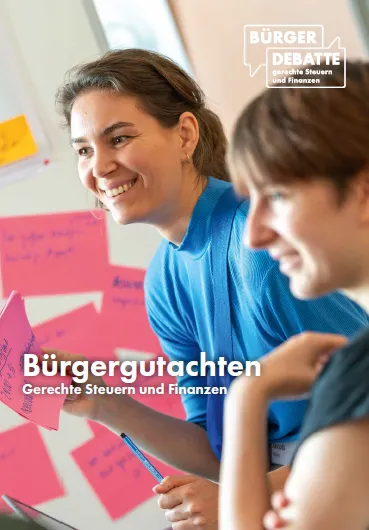
Citizens’ Dialogue on Fair Taxes and Public Finance

Programm- und Projektbroschüren

Germany’s public finances are under pressure. Climate change, the war in Ukraine, economic structural change, the renewal of infrastructure, and an aging society—all of this costs a great deal of money and fuels distributional conflicts. For this reason, it is necessary to discuss key strategic decisions. What can and do we, as a society, still afford? And how can we distribute the burdens fairly? The public debate on these questions is shaped by entrenched camps. Many citizens lack the necessary knowledge about taxes and public finance for a fact‑based discussion.
The Citizens’ Dialogue on Fair Taxes and Public Finance set out to explore how things could be done differently. This publication describes how the dialogue was conducted and summarizes the experiences and outcomes. Participants debated complex and often abstract issues—from inheritance tax and pension insurance to a federal tax administration. In the end, despite a diversity of views, they agreed on a total of 13 recommendations, which are published in this citizens’ report. The dialogue shows that engaging citizens in discussions about taxes and public finance is not only urgently needed; it can work—and it is worthwhile.


Mehr Demokratie e. V., Bund der Steuerzahler e. V., Verein zur Förderung der Steuergerechtigkeit e. V

Authors

nexus Institut für Kooperationsmanagement und interdisziplinäre Forschung GmbH

Image
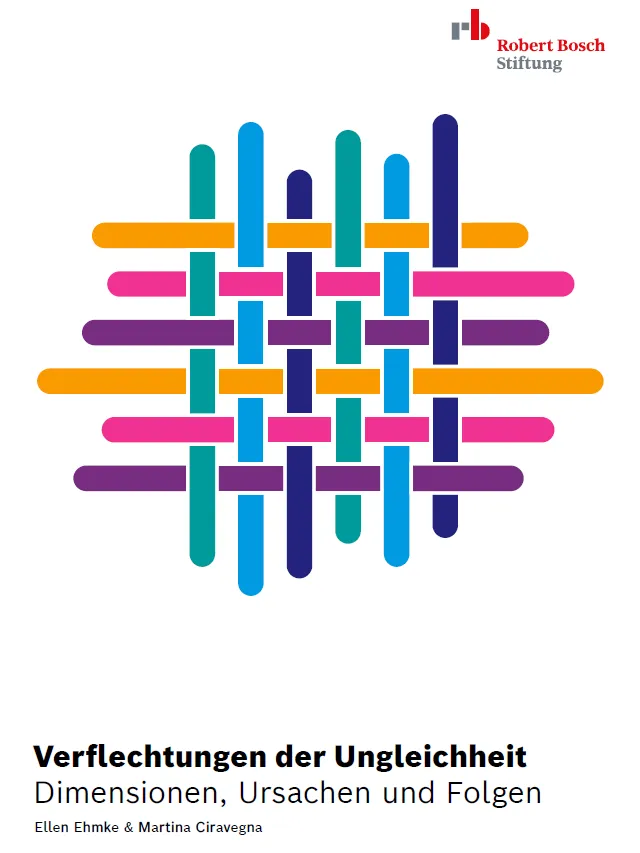
Cover Verflechtungen der Ungleichheit_600x800.png
Download PDF

The Fabric of Inequalities

2025

Inequalities today permeate all areas of our society. They shape the distribution of income and wealth as well as equal opportunities based on factors like gender, origin, or disability. In this report, Ellen Ehmke, Senior Expert at the Robert Bosch Stiftung, and Martina Ciravegna, formerly with the Robert Bosch Stiftung and now Projekt Officer at the Deutschlandstiftung Integration, explore the complex nature of these inequalities.

The authors explain different dimensions of inequality, ranging from “vertical”  differences in income and wealth to “horizontal” inequalities between social groups. They show how inequalities overlap and interconnect, creating a dense fabric that grants advantages to some while holding back others. The paper also looks at the historical roots of these inequalities: the legacy of colonialism, unequal use of natural resources, or unpaid care work. It highlights how these mechanisms continue to affect societies today.

The text illustrates why inequality harms everyone and not only those experiencing poverty and exclusion. Inequalities hinder opportunities for personal development and erode the social cohesion of societies. They undermine trust in democracies and weaken our collective ability to respond to crises.

Finally, the report presents ideas and approaches on how to address inequalities at a systemic level. At the center lies the belief that tackling inequality is a question of the distribution of power. The paper also introduces some partner organizations with which the Robert Bosch Stiftung collaborates to address inequalities.

Robert Bosch Stiftung

Authors

Ellen Ehmke and Martina Ciravegna