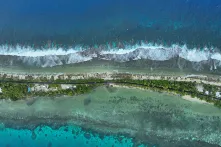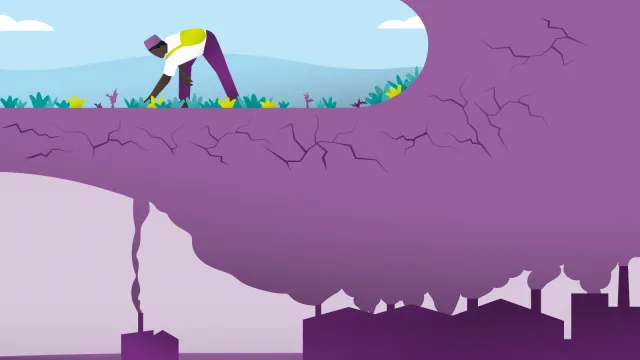
Climate change affects us all. However, its consequences are unevenly distributed. Those in countries of the Global South have been particularly affected by the consequences of the climate crisis, even though they are only responsible for a fraction of global greenhouse gas emissions. Large groups of people are now facing the challenges of a climate crisis that they did not cause and are confronted with existential questions: Can they continue to live and survive in their homelands with dignity - and, if so, how?
Climate change is exacerbating the already difficult living conditions in the Global South. In the Sahel region, for example, temperatures are rising 1.5 times faster than the global average, leading to increased droughts, flooding, and crop failures. At the same time, the countries of the Sahel hardly contribute to global CO2 emissions. Take Niger, for example: A total of 0.12 tons of CO2 emissions per capita were generated in 2022. For comparison, in Germany, the same figure was eight tons per capita.
How can this inequality be resolved? Together with the director of the Climate Justice Resilience Fund Heather McGray, we clarify the most important questions surrounding the topic of climate justice.
Climate Justice Resilience Fund (CJRF)
The CJRF puts people at the center of climate action and awards grants to women, young people, and indigenous groups to support them in developing and sharing climate resilience solutions. The CJRF is backed by a consortium of foundations, including the Robert Bosch Stiftung. Since its foundation in 2016, the CJRF has provided 25 million US dollars for over 40 funding partnerships worldwide.
What does climate justice mean?
Western industrialized nations bear a historic responsibility for the climate crisis due to decades of high emissions. At the same time, their financial prosperity enables them to cushion the effects of climate change, for example by providing compensation for crop failures. They can also prepare for extreme weather events in the long term. Many countries in the Global South do not have these opportunities, although they are also affected. There, climate change impacts are becoming a threat to the health and lives of those already affected by existing inequalities and injustices, such as indigenous groups and local communities, women, and young people.
Civil society actors and affected population groups are therefore calling for genuine participation in climate policy decision-making processes and in the implementation of these decisions in their countries, adapted to their local context and needs.
![[DE Copy] Klimagerechtigkeit_800x600_PiaBublies.png](/sites/default/files/styles/bosch_original_medium/public/images/media/2024-04/Klimagerechtigkeit_Illu_02_800x600.png.webp?itok=7yTwSCGE)
To what extent are the consequences of climate change distributed (un)fairly?
Countries in the Global South are particularly affected by extreme weather events such as storms, droughts, floods, and rising sea levels. Not only do they have to deal with the acute consequences of these events in the short term, but they must also adapt to different circumstances in the long term. Heather McGray: "If you are a poor fisherman or fisherwoman, in a place where all the fish are leaving because the water is too warm, it has a really profound effect. Or if you are a farmer whose soil is full of salt, then your livelihood will be taken away from you."
The fact that the consequences of climate change are being felt so strongly in the Global South is also inextricably linked to the distribution of goods and power on our planet. Other countries that have the necessary resources and influence can do more at the international level to compensate for climate damage in their region. "And the history of colonization also plays a role here", explains McGray. "With the privatization of land, for example, restrictions were imposed on nomadic and semi-nomadic herders. They used to have the flexibility to move their herds to places where the grass was green during dry spells. That is no longer possible in many places today." Some population groups cannot escape the consequences of climate change, and often they have nothing to counteract them.

"The dominance of Western countries is beginning to falter. It is time to recognize the unjust world order."
Why is a people-centered approach to climate policy important?
People in the Global South often do not have the necessary resources to protect themselves effectively against risks or to recover from the consequences of a disaster. They have neither the necessary financial means nor the required mobility or technology. Few people are insured. Members of indigenous groups, women, children, elderly, and those with disabilities are also often socially disadvantaged as well as denied participation in political decision-making processes.
McGray sees a great need for action here: "The consequences of climate change have been ignored for far too long. People lose land, they lose their homes. They experience trauma in connection with climate change." Support and funding are needed to give these people new prospects.
What is international climate policy doing to support greater climate justice?
The debate on climate justice initially revolved around the greenhouse gas savings of the historically responsible industrialized nations and the contribution of countries with currently high emissions, such as China and India, to climate protection goals. Climate justice is now understood to mean that those responsible must contribute financially to necessary adaptation strategies, and that groups are compensated for losses and damage that have already occurred.
The countries of the Global South have long been calling for financial compensation for the economic, ecological, cultural, and social losses and damage that become more dramatic with every additional degree of global warming. A breakthrough was achieved last December at the World Climate Change Conference in Dubai (COP 28) with the agreement on a "Loss and Damage Fund", into which the perpetrators of climate change and the largest emitters are to pay. However, questions of organization and financial participation are still being debated.
Another important step at the COP 28 towards greater climate justice was the conclusion of agreements on the Global Goal on Adaptation, whose regulations are intended to drive forward targeted adaptation measures in each country. However, it is still unclear how and by whom adaptation strategies will be financed. Civil society actors and population groups particularly affected by the climate crisis are demanding to be involved in decision-making processes and the design of measures in order to ensure a just transition.
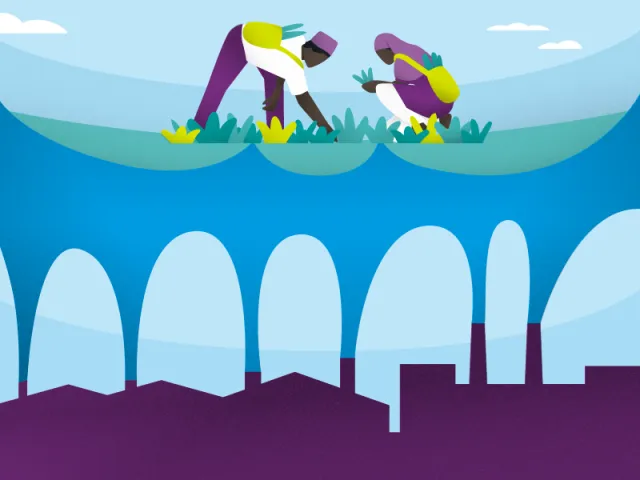
What contributes to greater climate justice?
The Climate Justice Resilience Fund has key recommendations for researchers, financiers, and practitioners to further advance climate justice. In order to shape a fairer future together, it is important to link local climate protection measures with global efforts. To this end, the complexity and uniqueness of local contexts must be considered. Instead of replicating programs, donors should develop flexible processes. In order to take all needs into account, in-depth co-design and cooperation with local communities is necessary. Furthermore, power dynamics and the decentralization of power on the ground must be recognized - a crucial point for just climate protection. Moreover, big changes take time. The Climate Justice Resilience Fund therefore recommends that donors be patient, invest in the long term, and respect different cultural time frames.


![[DE Copy] janineoswaldfotografie_RBS_final-800x600.jpg](/sites/default/files/styles/bosch_3d2_small/public/images/media/2026-05/janineoswaldfotografie_RBS_final-800x600.jpg.webp?h=827069f2&itok=RxPGzY-1)