2024 is not only a major election year for the world, but also a big year for international climate policy. This year will see conferences on all of the three major international treaties that were agreed at the UN Conference on Environment and Development in Rio de Janeiro in 1992: the United Nations Framework Convention on Climate Change (UNFCCC), the United Nations Convention to Combat Desertification (UNCCD) and the Convention on Biological Diversity (UNCBD).
One aspect relevant to all three Conventions is land use. In all the scenarios in which we succeed in limiting global warming to 1.5 degrees – a key target defined in the UNFCCC – we will need carbon sinks. These can include areas that have been reforested and are thus able to absorb more CO2. To preserve biodiversity, which is the goal of the UNCBD, we likewise need to designate large natural conservation areas. And to prevent desertification and land degradation, as the UNCCD aims to do, we must focus on land use and change the way it is farmed, switching for example to agro-ecological agricultural methods.
This major year for climate policy is a unique opportunity to strengthen the synergies between the three UN Conventions and to address the topic of land use in an interdisciplinary manner. After all, an ambitious climate policy also means an ambitious land use policy.
Indigenous and local communities treat land and forests with greater sensitivity
Using land differently and more sustainably opens up many opportunities for climate change mitigation, but also involves some risks. One particular problem is the fact that climate change mitigation or biodiversity protection measures could violate the land rights of indigenous or local communities. For example, companies that trade emission allowances on the international carbon market have in the past driven communities from their land in order to plant trees there on an industrial scale. This is neither sustainable nor good for biodiversity, nor does this form of alleged climate change mitigation respect the rights of land users.
Data reveal that forests and biodiversity thrive best in places where indigenous or local communities have the rights to the land. Globally speaking, deforestation rates in regions where land is managed by indigenous groups are roughly a fifth lower than elsewhere. In some regions of the Amazon, deforestation even occurs at around half the rate it does in other forested areas.
At the Robert Bosch Stiftung, we are therefore committed to ensuring that the legitimate land rights of indigenous and local communities, and especially the land rights of women, are protected in international climate policy and that women are involved in shaping land policy. In many parts of the world, it is women who work the land and take care to preserve it for future generations. To this day, however, they often lack guaranteed access to the land, as it tends to be inherited and owned by men. Although four out of five farmers worldwide are female and women produce half of our food, studies estimate that only 20 percent of landowners are female.
International agreements on climate change mitigation, biodiversity preservation and protection against land degradation therefore need to consider the complex local land access, control and ownership conditions. After all, land rights apply not only to legally and formally recognized property; they should also encompass collective rights and limited usage rights such as the seasonal grazing rights of herders or the rights of long-term tenants to land they have been farming for generations. It is important to acknowledge, respect and protect legitimate land and usage rights, especially women’s access and ownership rights.
If these rights are acknowledged in the international climate debate, this can also generate positive impetus for national lawmaking in various countries. At the same time, it can provide civil society organizations and local communities with new leverage when it comes to defending and demanding their land and self-determination rights.
Women's Land Rights Initiative
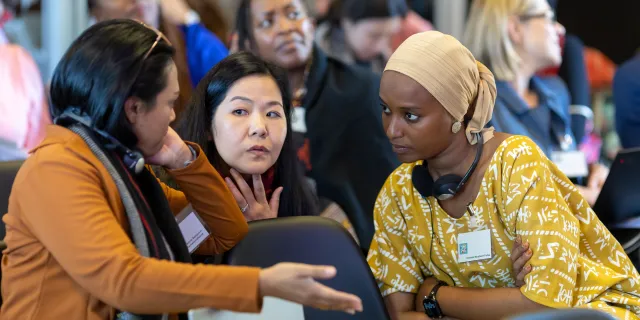
How can we strengthen women's land rights – and how can we use the Rio Conventions to do so? This was the topic of a meeting of the Women's Land Rights Initiative, which we at the Robert Bosch Stiftung organized together with the think tank TMG Research and representatives of the UNCCD, UNCBD and UNFCCC. Read the report, including many voices from activists worldwide.
In June 2024, the Robert Bosch Stiftung joined the TMG Think Tank for Sustainability, the secretariats of the three Rio Conventions UNCCD, UNCBD and UNFCCC and numerous international NGOs and grassroots organizations in a discussion of how to safeguard the land rights of women in the international Rio Conventions on climate, biodiversity and land degradation and to shape the transformation of land use in a socially just manner.
These are three of the key findings:
- It is particularly grassroots organizations led by women that drive forward the protection and securing of legitimate land rights for women in different local contexts, thereby making a vital contribution to climate change adaptation and mitigation. These organizations must lead the way when it is a question of anchoring women’s land rights in the international Rio Conventions and their implementation.
- New mechanisms to fund climate change mitigation and adaptation measures are needed to safeguard the land rights of women. Existing funding mechanisms, for example via the Global Environment Facility (GEF), are extremely complex and time-consuming to apply for and manage. They are not suitable for supporting local organizations in their efforts to protect women’s land rights. Flexible philanthropic funding with easy-to-access application procedures can make an important contribution to supporting grassroots activities that promote women’s land rights. Furthermore, foundations should campaign for a reform of the leading climate funds and use their expertise to help them find the best way to design applications for grassroots organizations.
- Better coordination is also needed between the representatives of the Conventions at the national level, the National Focal Points, and closer liaising between the National Focal Points and the grassroots movements in their respective countries. This can create new scope for influencing the way the Conventions are implemented at the national level and help anchor women’s land rights prospects in global decision-making processes. In this context, the women’s and gender caucuses of the Rio Conventions can also serve as important allies, as they aim to achieve equal opportunities and promote women’s rights in all processes and agreements. They should intensify their cooperation and focus on women’s land rights, thereby amplifying the voices of grassroots organizations.