Social diversity is a reality in Germany. At the same time, however, our ability to live together amid diversity is under enormous pressure: a constant stream of new crises is wearing people down or overwhelming them. The economic downturn is fueling fears of loss and leading to protectionism against others, especially “foreigners.” The increasing individualization and visibility of formerly marginalized groups is making some people uncomfortable.
Downward trend across all German federal states
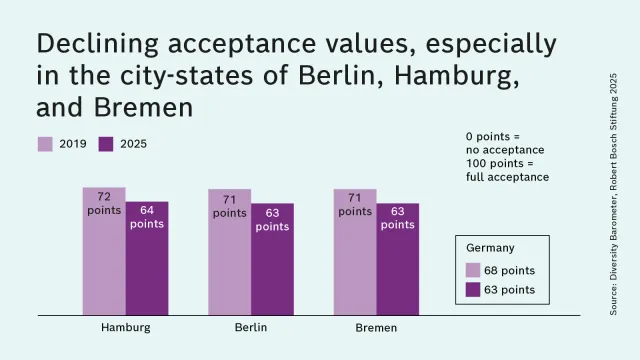
This is not without consequences. Acceptance of diversity in Germany has declined significantly in recent years, as our representative Diversity Barometer study shows. According to the overall diversity index, based on a scale of 0 to 100 points, the value for the acceptance of diversity in Germany currently stands at 63 points. This is well above the scale median of 50. At the same time, however, this value has fallen by five points compared to 2019, when the overall diversity index for Germany was still at 68 points.
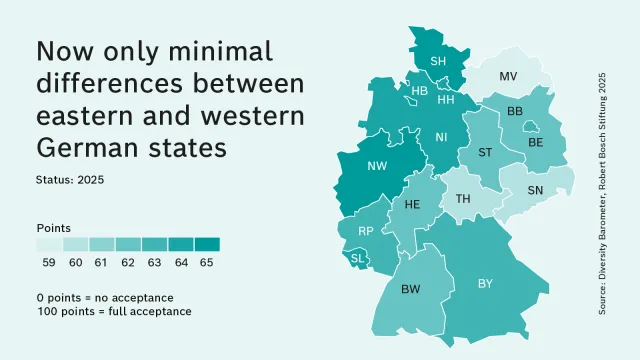
This trend can be observed in (almost) all federal states. Particularly striking is the fact that acceptance of diversity has declined more sharply in western Germany than in the east in recent years, with the west now approaching the once poorer values in the east. A particularly sharp decline can be seen in the city states of Hamburg, Berlin, and Bremen—once strongholds of acceptance of diversity.
Low acceptance values especially for ethnic origin and religion
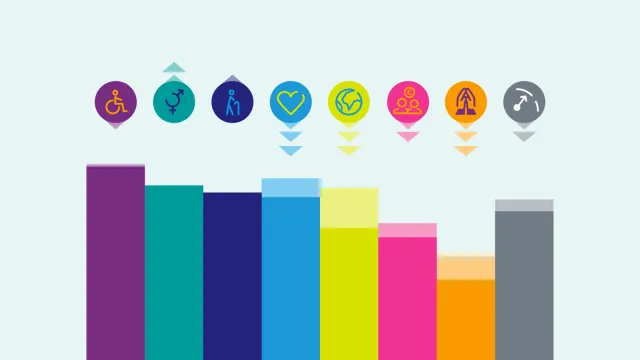
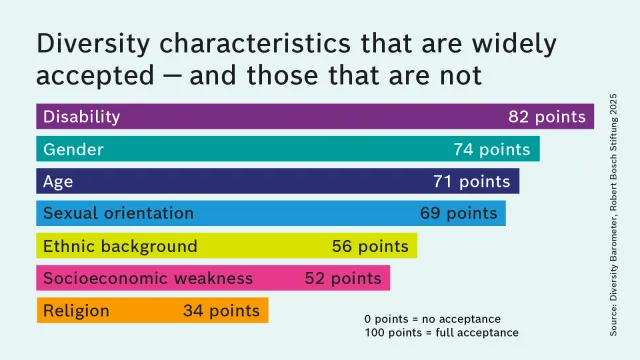
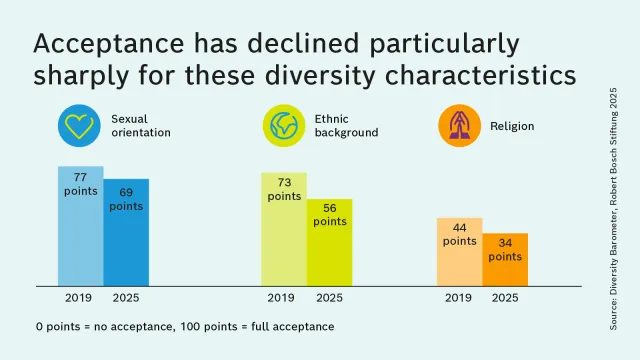
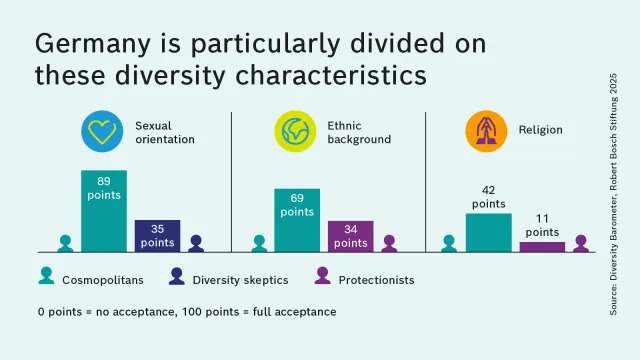
Looking at individual dimensions of diversity, the acceptance of different sexual orientations and, in particular, different ethnic backgrounds and religions has declined significantly, in line with dominant public debates. Acceptance of ethnic diversity has fallen dramatically, with a loss of 16 points. These issues also exhibit a particularly high potential for polarization between different groups of people and for social division.
There is also even less acceptance of socio-economic weakness than in 2019. The picture is more encouraging for the other dimensions of diversity, namely age, disability, and gender. Here, acceptance levels have remained stable and in some cases even improved.
Individual approaches to diversity: These patterns are emerging in German society
The study of personality patterns, which was also part of the investigation, provides some clues about which factors influence individual acceptance of diversity. According to the study, the strongest positive influence is an individual's capacity for empathy, i.e., the ability to put oneself in other people's shoes, understand their circumstances, and recognize their needs.
On the other hand, a pronounced protectionism of prosperity is particularly detrimental to the acceptance of diversity. This refers to the unwillingness to share socially generated goods with other stakeholders. However, the study also shows that people who live in a heterogeneous environment or consciously seek out such an environment are more open to and positive towards diversity.
How we can promote acceptance of diversity – and strengthen social cohesion
The Diversity Barometer confirms that when people encounter each other, it not only supports their acceptance of social diversity, but also their appreciation of it. This much is certain: Social diversity will continue to increase in the future. To keep social cohesion from eroding, we must all contribute to shaping this diversity.
The study also identifies ways for us to promote the acceptance of diversity: through dialogue and knowledge sharing; by strengthening our democracy, defending fundamental rights and values, and opposing all forms of discrimination; by giving greater recognition to individual circumstances and achievements; and by refraining from divisive rhetoric, simplifications, generalizations, and prejudices. All of this makes a society not only more livable, but also more crisis-proof and resilient to the challenges of our time, which we always face together.

![[DE Copy] DRF_Malawi_Teaser](/sites/default/files/styles/bosch_3d2_small/public/images/media/2025-04/800_600_Malawi%20GC%20unity%20Kopie.jpg.webp?h=79422251&itok=3Rt5IxGB)