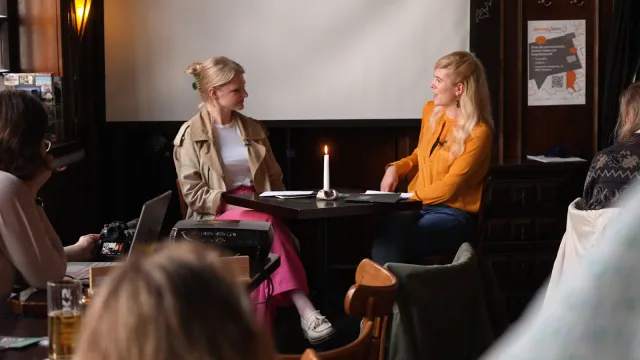
Energy prices, climate change, migration – there are political debates that have a high potential for conflict and polarization. Whether on the street or in the family, constructive dialogue often seems difficult or even impossible. Yet it is part of democracy to represent, discuss, and endure different opinions.
But how can we ensure that democratic discussions remain lively and that we do not divide into hostile camps? The demoSlam format offers an approach to this by bringing together people with different convictions and engaging them in dialogue. It is not about simply throwing arguments at each other, but about being curious, being able to endure different points of view, and finding common ground. Democracy also means being able to deal with people who disagree with each other while still having a good and productive dialogue.
In our video report, we accompanied two demoSlam participants before and after their performance in Eisenach and spoke to the organizer of the format about its importance for democracy, understanding, and polarization.
Initially a literary presentation competition, slamming has been further developed in recent years, for example as a science slam. Each slam format is about both the personal expression of the participants and interaction with the audience. At demoSlam, the focus is on selected social debates, conflicts, and controversies on which everyone present has their own opinion. Before taking to the stage, the slammers are prepared in workshops, particularly with regard to tolerance of ambiguity, as well as conflict resolution. The audience also plays an important role in the demoSlam, as they should be stimulated by the democratic discussion and can contribute to the dialogue themselves.
Tolerance of ambiguity
People who are tolerant of ambiguity are able to tolerate contradictions, differences, and ambiguous information. Even if the other person’s opinion seems difficult to understand or even unacceptable, ambiguity-tolerant people can respond to it – without reacting aggressively or judging the that person’s opinion one-sidedly.