![[DE Copy] Intersectional_Principles_Header](/sites/default/files/styles/bosch_16d9_medium/public/images/media/2023-02/Intersectionality%20Principles_Webmagazin-Zuschnitt_1200x900px_Kruthika_NS.jpg.webp?h=c282529e&itok=ssHp2vki)
What does intersectionality mean?
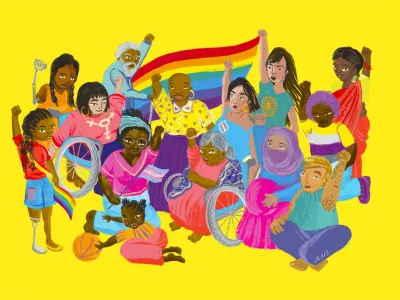
Intersectionality refers to the fact that every person embodies a combination of characteristics—such as gender, ethnic background, class, disability, religion, or sexual orientation—and that these characteristics can interact in ways that lead to multiple layers of privilege or discrimination.
The term was coined in the late 1980s by American legal scholar Kimberlé Crenshaw. She focused particularly on how these characteristics influence one another and how this interplay can intensify discrimination. For example, a Black woman may face disadvantages not only because of her gender but also due to her ethnicity—often in ways that cannot be easily separated or categorized.
Who is affected by intersectionality?
Intersectionality affects everyone, as each individual has a unique combination of diverse characteristics. In practice, women, people with migration backgrounds, members of the LGBTQ+ community, and people with disabilities are especially likely to experience multiple forms of discrimination.
The extent of disadvantage or privilege can vary depending on the context. For instance, a Black woman in a leadership position may face both racism and sexism—but her professional status might also grant her access to influential decision-makers who typically overlook non-white and non-male voices. The complexity of individual life experiences makes it essential to consider the overlaps and interactions between different identity traits.
How does intersectionality help us move forward?
An intersectional perspective helps identify the root causes of inequality and oppression, provides a deeper understanding of power structures—and ultimately enables us to change them. Intersectionality holds the potential to foster greater social justice, solidarity, and fairness.
That’s why the Robert Bosch Stiftung integrates the intersectional approach into many aspects of our work and funding initiatives.
In numerous projects, we support people who are (multiply) marginalized, helping amplify their voices in political and social debates. We also aim to promote the practical application of intersectionality. Through our funding program Reducing Inequalities through Intersectional Practice, we have worked with partners to explore proven intersectional approaches and derive principles for truly intersectional practices across various fields—from politics and language to artificial intelligence.