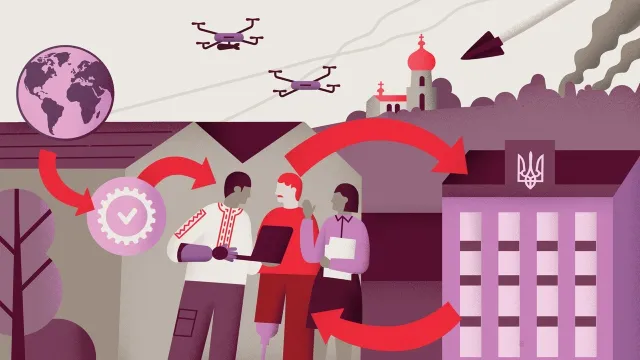
When people talk about innovations in Ukraine in 2026, the conversation usually centers on drones or automated air defense systems. But “in the fifth year of Russia’s war of aggression, new ideas and approaches are emerging across the country and in many areas of society,” says Markus Lux, Head of the Ukraine Special Division at the Robert Bosch Stiftung. “I find it impressive how people in Ukraine are working to improve conditions despite the immense pressure.”
That is why, besides funding projects, the Robert Bosch Stiftung is also focusing on innovative funding models such as Social Impact Bonds or the Citizen Token System. Through them individuals can earn a say in the distribution of funding by engaging in social initiatives. “We want to involve citizens and kickstart self-reinforcing socioeconomic cycles,” Markus explains.
The goal here is not so much to close Ukraine’s acute funding gap. As Markus points out, the World Bank reckons that the country will need nearly €600 billion for reconstruction in the medium term. “But we must not underestimate the value of sustained social engagement,” he says.
As with any experiment, “the risk of failure is real,” he adds. But the pilot projects offer an opportunity to learn new things and gain experience. The Social Impact Bonds and Citizen Token System also align with the strategy of the Robert Bosch Stiftung’s Ukraine Initiative, which is increasingly focusing on power sharing in funding: defining goals with local partners and setting up a project “that slowly matures and develops in directions never even imagined”.
Of course, Markus hopes that this initiative will also inspire government funding agencies worldwide “to embrace such grassroots processes”. In any case, it’s not the Ukrainians that are holding back. “30 percent of them are engaged in social causes in the midst of this war,” he points out, “and there’s this willingness to roll up their sleeves and compromise.” We can learn from that—and not just for Ukraine.
Social Impact Bonds: Municipalities Step In When Projects Succeed
Alina Tokmylenko is a sporty woman who likes to go for a run before work to clear her head and order her thoughts. When she asked her colleagues in the town of Voznesensk in the Mykolaiv Oblast about where to go for a nice run, all she heard was: “Don’t do it! It’s too dangerous.” At the start of the Russian invasion, the town of 30,000 residents was right on the front line and temporarily occupied by Russian forces—and even today, the fighting is only 140 km away. Russian drone and missile attacks happen day after day.
Alina Tokmylenko leaves the house anyway – and the people of Voznesensk still go to the market, which continues to define city life even in the fifth post-invasion year. “We can’t wait for the war to end,” she says. “We have to take our lives into our own hands and tackle social challenges.”
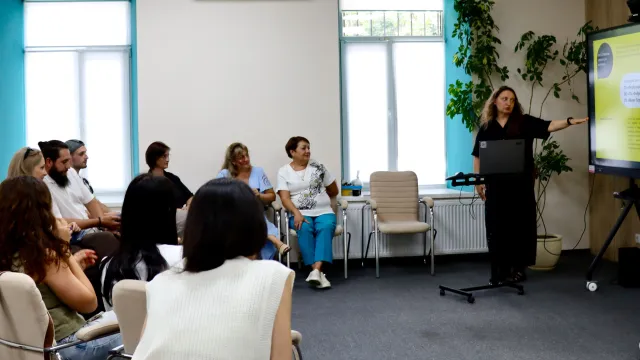
Alina works as the Social Impact Bonds Lead at The Possible, an alliance of businesses, NGOs and partners working to rebuild Ukraine from the ground up. In Voznesensk, she runs a pilot project for Social Impact Bonds financed by the Robert Bosch Stiftung. This innovative model aims to open up new sources of reconstruction funding and support initiatives that are closely tied to the local economy and measured against concrete results. “We don’t have any ready-made solutions,” Alina says. “Our message is that we’ll support you, but no one knows your city and your needs better than you do.”
At the start of the pilot project, a list of priorities was developed in workshops with local stakeholders to determine what was the greatest need. It quickly became clear that one of the community’s most urgent priorities was to support veterans on their return to civilian life. “These aren’t passive people who need help,” she says. “They’ve worked under enormous pressure and possess very specific skills.”
Via the Social Impact Bonds model, an organization such as the Robert Bosch Stiftung can provide capital for projects that help veterans start their own businesses, find new jobs, or cope with psychological trauma. Such a process has just begun. NGOs and social service providers were able to apply this summer and implementation will start this fall. “This isn’t about good intentions, but efficiency,” Alina says. If the agreed results are achieved during the project period, the municipality is committed to investing an amount equal to the original grant in these or similar initiatives in their next budget.
“We’re working closely with the city’s administrative staff because they’re the ones who subsequently have to carry on with the work,” Alina says. This model can be adapted for use in other municipalities, but its implementation should always take into account each municipality’s specific needs, context, and unique characteristics.
At a Glance
Social Impact Bonds
How exactly do Social Impact Bonds work in Ukraine?
In a Social Impact Bond, an investor or donor—such as a foundation—provides upfront capital to finance a social initiative. Additional public funding is contingent on the achievement of predefined outcomes. In Ukraine, municipalities are currently subject to legal restrictions regarding the acceptance and repayment of this type of private capital. But the organization The Possible has found a solution: If the predefined goals are achieved and independently verified, the municipality commits to allocating a corresponding amount in their next budget to continue or expand the successful initiatives.
Who decides whether the goals have been achieved?
Neither the investors nor the city’s administrative staff, but an independent evaluator. In the pilot project in Voznesensk, an organization known as Restart is assessing progress based on specific, predefined indicators. Only when this independent evaluation has confirmed that the agreed results have been achieved will the city’s administrative staff trigger the renewed investment.
What exactly are the funding flows like?
The Robert Bosch Stiftung provides seed funding for the pilot project. The Possible designs and manages the Social Impact Bond pilot project, administers the funds, and coordinates the various parties. The Possible then provides funds to selected local organizations and service providers in Voznesensk to implement the measures on the ground, i.e., to support veterans in terms of employment, entrepreneurship, mental health and rehabilitation.
This structure enables the city’s administrative staff to test a results-oriented financing model without having to commit public funds in advance. Instead, Voznesensk is committed to investing in successful initiatives once the agreed outcomes have been achieved and verified by an independent impact evaluator. In this way, philanthropic capital can contribute to the financing and testing of new approaches, while public funds are only made available after proven results have been demonstrated.
The Citizen Token System: More Say Over Shared Resources
It’s a typical day in Odesa: Electricity and water cut off after recent Russian attacks. Vadim Georgienko has to make his video call from an internet café, with a generator rattling in the background. The quality of the connection is terrible. But things must go on: “Who knows what winter will bring?”
Vadim hasn’t followed a typical NGO career – his CV spans sectors from business and civic tech to local government – and he’s “always looking for solutions that work across borders”. He works with Moloda Gromada Foundation, which coordinates a partner network in Ukraine for the Citizen Token System. The aim is to develop “a new understanding of civil society”.
The problem Vadim wants to solve is older than the war. There's a global paradox, he says, that programs to promote democracy are meeting their targets on paper – yet democracy itself is under pressure in many places. One reason, Vadim says, is that the usual forms of participation don't reach the majority of people and give them only limited influence. “In recent years, billions in external aid have flowed into Ukraine,” he points out. “But people have barely any say in how those funds are spent.”
“Resilience grows with how much power a community is ready to share with its residents.”
Vadim Georgienko
Since 2022, the Russian invasion has acted like a magnifying glass that has mercilessly exposed this problem, he says. “Ukraine has switched into survival mode; all resources are flowing into the army, resisting the invasion, and the real-time reconstruction of critical infrastructure.”
That, for Vadim, makes Ukraine an exceptionally demanding environment for testing democratic innovations: “The war is the ultimate stress test. What we learn here could help other communities strengthen their resilience through new forms of citizen-led governance.”
So, how does a Citizen Token System work in this extreme environment? When someone gets involved in a pilot community – in childcare or a veterans' project – their contribution is recorded and confirmed, and in return they receive a token. It's a kind of receipt that documents what they did – “and has a value, almost like a postage stamp or a banknote”, he explains.
The tokens then give them a say in how shared local resources are used, and the more someone has contributed, the more weight their voice carries. On that basis, the community decides together which local projects to fund, e.g., a school initiative or repairs to a public building. But the impact goes beyond the individual projects. “Resilience grows with how much power a community is ready to share with its residents,” Vadim says.
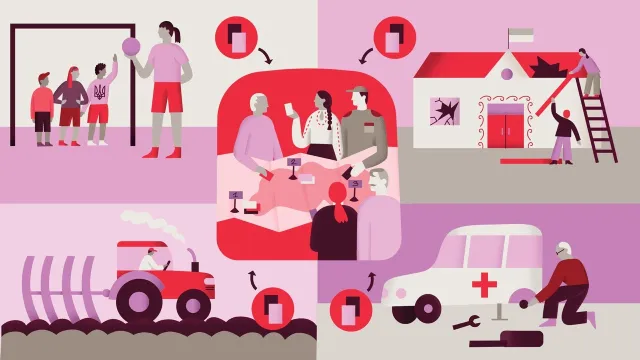
The first pilots in western Ukraine have moved past their initial funding phase and are now running on their own in a self-sustaining cycle that can continue without outside donor support. Training videos and best practices are now helping other communities to adopt the model.
It's an idea that’s both small and very big. Vadim talks about microprojects with budgets of just a few hundred euros, voted on with tokens and funded from local resources: environmental initiatives, small agricultural projects, knitting socks for front-line soldiers. But these projects aren't an end in themselves; they’re the building blocks of a self-sustaining cycle. Communities can start this process themselves, with initial support from Vadim's network.
What began as a single project is intended to become a lasting self-governance practice – and, spread across the country, change the democratic culture in Ukraine from the bottom up. “The real value isn't just the work people put in – it's the say it gives them over shared resources,” Vadim says. He calls it the “Inner Marshall Plan for Ukraine”.
At a Glance
Citizen Token System
What is a Citizen Token System?
The CTS links verified civic contributions to decision-making power over shared resources. People who contribute time, labor, materials or other agreed resources receive tokens that represent their share of decision-making power. The tokens are not money, but give their holders a corresponding say in deciding which local projects will receive public, community or donated resources. In this way, individual engagement is turned into a real voice in public decisions.
What process determines what tokens are awarded for?
This is regulated by trained local teams that bring together the municipal administration and civil society – local NGOs, youth councils, or volunteer groups. Guided by the needs voiced in the community, they draw up smart contracts – simple, publicly available sets of rules that define what problems are to be solved, what contributions are needed, and how many tokens will be awarded. The same team later checks residents' contributions against those rules and allocates the tokens accordingly. As the rules are drawn up publicly and locally, it is transparent to everyone what the tokens are awarded for – and they can be adapted to different groups and needs.
Where does the money come from and how does it stay in the system?
Everything starts with a pool of resources, which may come from a donation, foundation funds, e.g., from the Robert Bosch Stiftung, or a municipal budget. Whatever the source, the community itself votes with its tokens on how the money will be used. For economically viable projects, the funds can later be recouped and reallocated, creating a self-reinforcing cycle rather than one-off funding.


![[DE Copy] Panel der Robert Bosch Stiftung auf der Münchner Sicherheitskonferenz 2025 800x600](/sites/default/files/styles/bosch_3d2_small/public/images/media/2025-02/Header-MSC-Artikel-Karl-Josef%20Hildenbrand-800x600_0.jpg.webp?h=accb7969&itok=-6Ct_dY4)