Equal Partnerships

Programm- und Projektbroschüren
2023
Equal Partnerships

Gulu is one of Uganda's fastest growing intermediary cities. With about 150,000 people living in the city and more than 275,000 people living in the wider district, Gulu is the largest urban center in Uganda's northern region. Migration and (internal) displacement related to past civil wars, regional conflicts, economic inequality, climate change and environmental degradation play an important role in shaping the city of Gulu. As a result, various actors are addressing issues of human mobility in the city. To gain an overview of activities, partnerships and gaps in cooperation, the Equal Partnerships project conducted participatory field research and organized a local workshop in July 2022 in cooperation with the City of Gulu. The stakeholder mapping revealed that despite Uganda's internationally lauded "open" refugee policy, the predominant focus on refugee resettlement in rural settlements has rendered self-settled urban refugees highly invisible, limiting the capacity of local government, civil society and international organizations to support refugees in Gulu city.

Equal Partnerships

Authors

Lasse Juhl Morthorst, Janina Stürner-Siovitz

Equal Partnerships

Programm- und Projektbroschüren
2023
Equal Partnerships

The Kenyan city of Garissa, with a population of approximately 500,000, is the main urban center of Garissa County and a major economic hub in the region. Located 160 kilometers west of the Somali border and 100 kilometers southwest of the Dadaab refugee complex, Garissa faces significant challenges related to urban migration and displacement. To gain insights into the actors addressing migration and displacement, partnership dynamics and gaps in cooperation, the Equal Partnerships project conducted participatory field research and organized local workshops in partnership with Garissa County. The case study situates Garissa within the national and regional migration context, presents the results of stakeholder mapping, identifies opportunities and challenges for collaborative action on migration, and concludes with concrete policy recommendations for strengthening multi-stakeholder partnerships to address mixed migration in urban contexts.
Equal Partnerships

Authors

Pauline Cherunya, Daniel Provost

Image
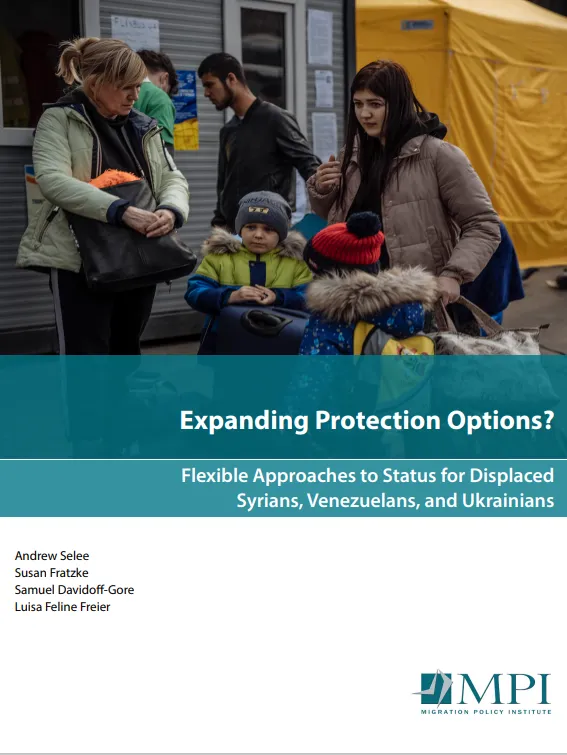
Cover of the publication Expanding Protection Options
Download PDF

Expanding Protection Options?

Expanding Protection Options?
2024
Expanding Protection Options?

Faced with displacement crises that have stretched asylum systems to their limits, countries have increasingly begun to use alternatives to traditional protection tools to provide displaced individuals with legal status and access to certain rights and forms of assistance. While such approaches are not completely new, they have gained prominence through national responses to three of the largest displacement crises of the post-World War II era: displacement from Syria, Venezuela, and Ukraine. The principal host governments in these three crises chose to provide legal status to millions of protection seekers by using existing immigration policies or new temporary statuses, rather than refugee or asylum systems.

This report—part of the Beyond Territorial Asylum: Making Protection Work in a Bordered World initiative led by MPI and the Robert Bosch Stiftung—examines each of these three cases, identifying similarities in the approaches taken to offering protection while recognizing the differences. The study explores the factors underpinning government decisions and their medium- to long-term implications, concluding with thoughts on what can be learned for future international displacement crises.

Migration Policy Institute

Authors

Andrew Selee, Susan Fratzke, Samuel Davidoff-Gore, Luisa Feline Freier

Image
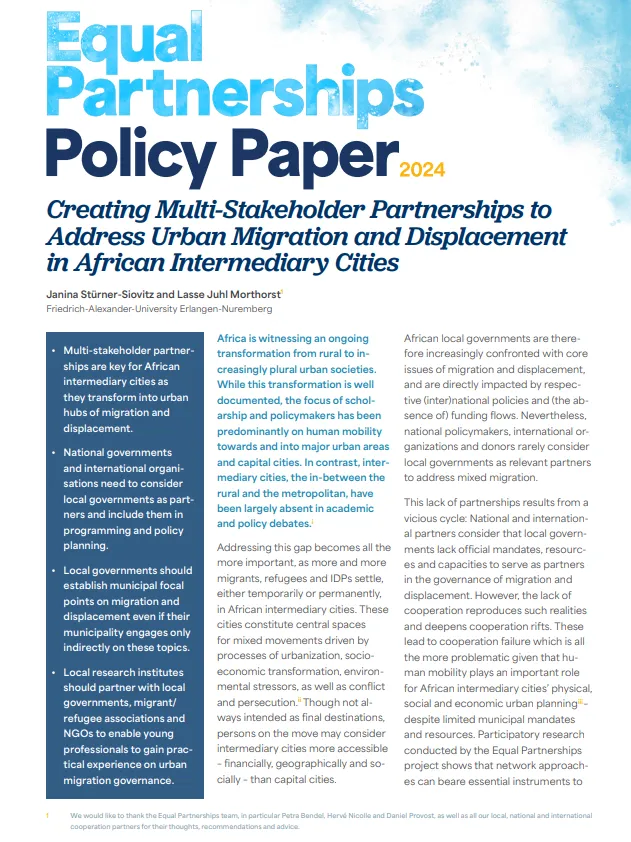
Cover Equal Partnerships Policy Papter_600x800
Download PDF

Equal Partnerships Policy Paper

Programm- und Projektbroschüren
Equal Partnerships Policy Paper

As Africa witnesses a profound transformation from rural to diverse urban societies, the spotlight has primarily focused on human mobility towards major urban centers. Yet, the crucial role of intermediary cities —bridging rural and metropolitan areas— remains overlooked in academic and policy discussions. In this policy paper, Janina Stürner-Siovitz and Lasse Juhl Morthorst from the Equal Partnerships Project, shed light on the vital yet neglected space of intermediary cities in Africa and explore what is needed on the local, national and international level to create sustainable multi-stakeholder partnerships to address urban migration processes.

Friedrich-Alexander-University Erlangen-Nuremberg

Authors

Janina Stürner-Siovitz and Lasse Juhl Morthorst

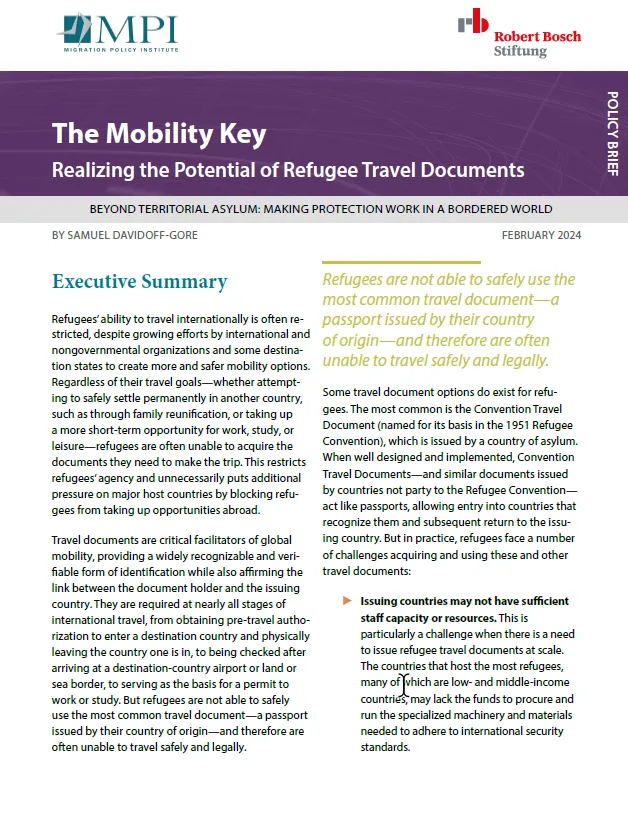
The Mobility Key

Programm- und Projektbroschüren
Der Schlüssel zur Mobilität

Governments are increasingly exploring new pathways for refugee mobility, including complementary ones that connect refugees to work or study opportunities in a country other than the one in which they first sought safety. However, this push to expand the future prospects of refugees is impeded by refugees' limited access to travel documents and restrictions on their use. As a result, refugees are often unable to travel internationally safely and legally. This limits their agency and keeps pressure on key refugee-hosting countries by preventing refugees from taking advantage of opportunities abroad. In this brief, Samuel Davidoff-Gore examines the types of travel documents available, the challenges refugees face in obtaining and using them, and the steps governments and other stakeholders could take to address these challenges. The brief is part of the Beyond Territorial Asylum: Making Protection Work in a Bordered World initiative undertaken by MPI and the Robert Bosch Stiftung. The initiative seeks to address challenges to asylum systems that are under immense pressure and seize the opportunity to explore and test new ways to facilitate access to protection that better support equity and result in more flexible, sustainable infrastructure. 
 

Migration Policy Institute

Authors

Samuel Davidoff-Gore

Image
[DE Copy] Meeting-skills_Publikation_600x800
Download PDF

Meeting Skill Needs for the Global Green Transition

Meeting Skill Needs for the Global Green Transition

The green transition is not just about expanding sustainability, it also creates an enormous demand for skilled workers. In this policy paper, Sam Huckstep and Helen Dempster examine the demand and supply dynamics of skills crucial to the green transition in both the Global South and North. Focusing on the installation and maintenance workforce in solar photovoltaic panels and heat pumps, their findings reveal a critical shortage of skilled workers in almost all ten countries studied. Particularly challenging is the scenario in the Global North, compelled to accelerate emission cuts amidst aging populations. To meet green transition targets, migration emerges as a vital complement to local training and reskilling efforts. While the global shortage of green-skilled workers must be recognized, the authors emphasize that such a skills-based migration strategy must be coupled with robust support for training and retaining talents locally. 

Center for Global Development

Authors

Sam Huckstep, Helen Dempster

Image
Mixed Migration Review 2023_600x800
Download PDF

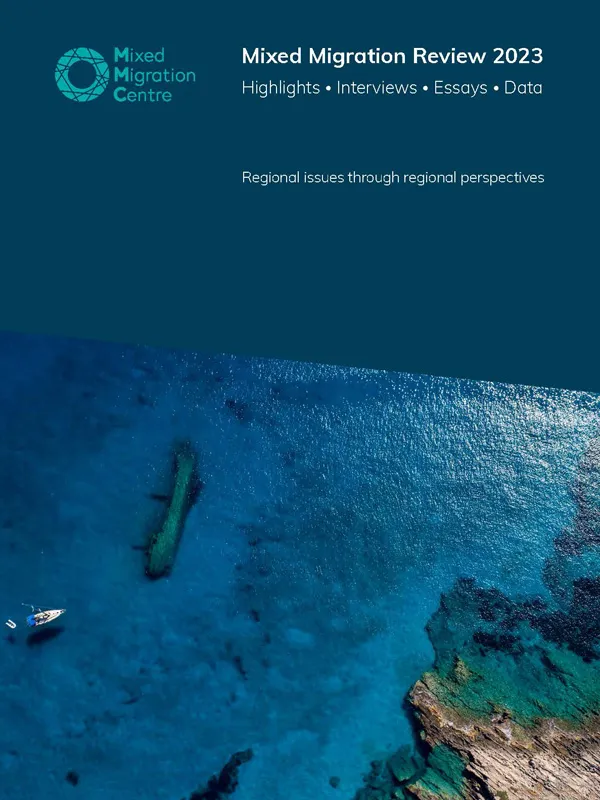
Mixed Migration Review 2023

Mixed Migration Review 2023
2023
Mixed Migration Review 2023

The Mixed Migration Review (MMR) is the flagship annual report of the Mixed Migration Centre, which was first published in 2018. This 2023 report presents a wide-ranging global review keeping track of all mixed migration events and policy developments over the year, and offers a deliberately regional focus, mainly through interviews with critical regional thinkers and practitioners in the sector, essays and snapshots spotlighting regional questions and in-depth and personal migrant stories.

Mixed Migration Centre
Image
[DE Copy] HPG_report_600x800
Download PDF

The failure to fund refugee-led organisations

The failure to fund refugee-led organisations
2023
The failure to fund refugee-led organisations

Refugee-led organisations (RLOs) are a crucial cog in the refugee-response machine, providing essential services to their communities, as well as being more likely to lead responses that are accountable, legitimate, transparent, effective and impactful. This paper highlights the findings from the first of a five-year research project analyzing the quantity and quality of funding to RLOs over time. The project – co-funded by the Open Society Foundations – is led by the Overseas Development Institute’s Humanitarian Policy Group and aims to provide rigorous and independent snapshots of funding over time and an evidence-based advocacy tool to improve the quantity and quality of funding that is directed to RLOs. 

HPG

Authors

Caitlin Sturridge et al.

Building Meaningful Refugee Participation into Protection Policymaking

Building Meaningful Refugee Participation into Protection Policymaking

This report — part of the Beyond Territorial Asylum: Making Protection Work in a Bordered World initiative led by the Migration Policy Institute and the Robert Bosch Stiftung — explores what motivates states, international organizations, and other actors to implement refugee participation initiatives, what forms these initiatives take, and what their limitations are. The study also proposes a preliminary theory of change (how such activities are intended to achieve their goals), a set of indicators to measure the influence of refugee participation on policy effectiveness, and recommendations for how such tools can be leveraged to improve refugee engagement and protection policies.

Migration Policy Institute

Authors

Uwezo Ramazani

Image
Cover GMF Brief
Download PDF

From Analogue to Digital: Current Procedures in Germany for Issuing Visas to Professionals

Bücher und Studien
2023
Von Analog zu Digital: Derzeitige Abläufe der Visaerteilung für Fachkräfte

Germany needs skilled labor migration. This requires effective migration authorities with scalable capacities. After all, the quality and speed of the application process also depend on the staffing and technical resources of the authorities. The digitalization of the application and decision-making processes can make a decisive contribution in this regard. This policy brief therefore focuses on the various institutions and actors involved in the immigration process. Taking a closer look at the existing communication channels and the state of data exchange in particular. Different data management systems and inconsistent forms of communication emerge as hurdles in the process. Accordingly, the policy brief makes concrete suggestions for improvements to simplify the immigration process, such as a personal data pool or the publication of the current processing time.
The publication is part of the "Dialogue on Tech and Migration, DoT.Mig." of the "Migration Strategy Group," a joint initiative of the Robert Bosch Stiftung, Bertelsmann Stiftung and the German Marshall Fund.

DoT.Mig

Authors

Marius Tollenaere, Ahu Çelik, Fragomen Global LLP