- High Levels of Confidence and Engagement: A nationwide survey conducted by the Robert Bosch Stiftung shows that 72 percent of civil society organizations in Germany are optimistic about their organizations’ future. Their confidence stems primarily from the commitment of their employees and volunteers and the direct impact of their work.
- Organizations Face Significant Structural Challenges: In addition to bureaucracy and a heavy administrative burden (73 percent), funding issues (64 percent), and staff shortages (60 percent), many organizations cite social polarization (46 percent) and a lack of political support (54 percent) as challenges. Sixteen percent of respondents report experiencing hostility or hate directed at their organization or its members.
- Call for Reliable Framework Conditions: To safeguard civil society’s long-term contribution to the common good, organizations need reliable funding and protection from political instrumentalization. This includes modernizing Germany’s nonprofit law as well as introducing flexible, long-term funding mechanisms such as the German Fund for Democracy, which helps sustain long-term engagement and provides greater planning security.
Berlin/Stuttgart, November 4, 2026: Despite the many challenges it faces, Germany’s organized civil society is remarkably resilient and forward-looking. This is one of the findings of the Robert Bosch Stiftung’s newly launched Confidence Barometer (Zuversichtsbarometer). For the nationwide survey, forsa interviewed 754 representatives of associations, foundations, and other nonprofit organizations across Germany. They work on a broad range of social issues, including welfare, education, the environment, culture, and sports.
Looking ahead to their organizations’ future, respondents are predominantly optimistic: 72 percent say they feel confident about what lies ahead. This confidence stems primarily from their own experiences and resources. Ninety-four percent cite the commitment of their employees and volunteers as their most important source of encouragement. Positive feedback from the people they serve (92 percent), as well as tangible successes and the visible impact of their work (90 percent), also strengthen their confidence in the future.
Funding Challenges, Staff Shortages, Polarization, and Hostility Put Pressure on Organizations
The Confidence Barometer also shows that conditions for civic engagement are challenging. In addition to structural problems such as bureaucracy and a heavy administrative burden (73 percent), uncertain funding (64 percent), and staff shortages and employee overload (60 percent), broader social developments are making the work of many organizations more difficult. Nearly half of respondents (46 percent) cite growing social polarization as a challenge in their day-to-day work. More than half of organizations (54 percent) also report a lack of political support. Sixteen percent say their organizations are affected by direct hostility or hate targeting the organization itself or individual members.
“Civil society organizations make an indispensable contribution to social cohesion. They demonstrate courage, responsibility, and a willingness to shape society, thereby strengthening the common good. Their optimism is good news,” says Ottilie Bälz, Senior Vice President, Global Issues, at the Robert Bosch Stiftung. At the same time, she notes that pressure on civil society organizations is growing. Civil society is extremely diverse: While large welfare associations generally operate from a stable position, smaller initiatives working locally to combat extremism and hate face noticeably tougher conditions.
Bälz says: “To fulfill their role over the long term, these organizations need reliable structures. This is particularly important where government funding is being withdrawn or organizations are coming under social and political pressure. A strong democracy needs a capable and independent civil society.”
Reliable Structures and Legal Certainty Safeguard Social Cohesion
In addition to long-term funding and support, a strong civil society requires clear legal frameworks. These enable organizations to participate effectively in public debate, promote democratic participation, and contribute their expertise to political decision-making processes. “Germany’s nonprofit law needs to be modernized to give civil society organizations greater legal certainty for their engagement in social and political issues,” says Bälz.
Strong partnerships for democracy are also needed to mitigate financial uncertainty and political pressure. Against this backdrop, the German Fund for Democracy was launched in spring 2026. It supports organizations that have come under pressure due to the loss of funding or political repression, particularly in the wake of the state elections in Saxony-Anhalt and Mecklenburg-Western Pomerania. The Robert Bosch Stiftung is the first foundation to contribute to the fund, providing €800,000. Funding covers staff, rent, and infrastructure costs, among other expenses, helping democratic initiatives maintain their ability to operate.
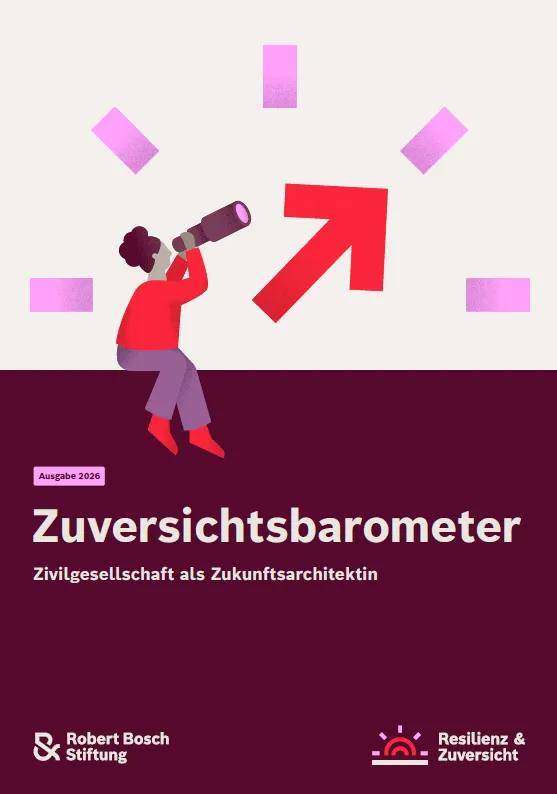
About the Confidence Barometer
For the first time, the Robert Bosch Stiftung presents a nationwide assessment of how civil society organizations in Germany view their future. The survey aims to shed light on the challenges organizations face, the factors that strengthen their confidence, and how they assess their future capacity to act.
On behalf of the Robert Bosch Stiftung, forsa surveyed 754 representatives of civil society organizations across Germany, including registered associations (e. V.), foundations, and nonprofit limited liability companies (gGmbHs). The survey was conducted from August 10 to September 4, 2026, using computer-assisted telephone interviews (CATI).