Climate Meets Local Government – Model Project on Citizens' Councils and Direct Democracy
![[DE Copy] Klima trifft Kommune_hoch](/sites/default/files/styles/bosch_4d3_medium/public/images/media/2025-04/Projektseite%20hoch_48738042623_96bdba5561_k.png.webp?h=35c5d4cc&itok=aMQkiLP4)
About the project
This innovative model project builds a bridge between deliberative and direct democracy in order to strengthen citizen participation at the local level. Citizens' councils have proven to be a useful addition to representative democracy in Germany. By involving a diverse range of perspectives from randomly selected citizens, not only can viable solutions to pressing problems be found, but trust in politics is also demonstrably strengthened. All too often, however, the recommendations of citizens' councils are not implemented or only very selectively by politicians, or are not seriously considered.
To increase the effectiveness of citizens' councils, the project therefore focuses on a democratic innovation: citizens' councils are combined with a council referendum. Citizens will then be able to vote on the proposals made by the citizens' councils in a binding referendum. The aim is to gain insights for potential scaling.
The participating municipalities are Osterburg (Saxony-Anhalt), Flensburg and Pinneberg (Schleswig-Holstein). Osterburg will be the first municipality to launch a citizens' council in autumn 2025 and discuss the city's cycling infrastructure planning. Flensburg will start in spring 2026 with a citizens' council on the topic of mobility. In Pinneberg, the topic is currently being narrowed down further.
Why are we running the project?
Political transformations such as climate protection are increasingly meeting with resistance and a lack of acceptance among the population. Citizens' assemblies have the potential to support these transformations by discussing complex and controversial issues in a differentiated manner and developing high-quality, ambitious recommendations. Citizens' assemblies have shown that they can develop well-founded recommendations for action that are supported by a broad section of the population. However, experience in Germany and internationally shows that these recommendations are often inadequately implemented by political decision-makers. This damages the legitimacy and reputation of citizens' assemblies and hinders necessary political change. The project aims to contribute to making the implementation of citizens' assembly recommendations more effective.
What is our goal?
innovative form of citizen participation to make informed and democratically legitimate decisions that are supported by a broad section of the population.
The project aims to spark a comprehensive social debate on climate protection in the municipality and show that far-reaching political changes can be implemented with the consent of the population. In doing so, we want to highlight how deliberative and direct democracy can complement each other in a meaningful way to tackle pressing challenges together. The model project represents a democratic innovation because it combines dialogic citizen participation with direct democracy to complement representative democracy in a meaningful way.
How does the project work?
In the first phase of the project, council resolutions approve the implementation of both a climate citizens' assembly and a council referendum. In the second phase, a citizens' assembly is held, followed by the council referendum in the third phase. Two different variants are to be tested in a total of three to four municipalities:
Variant 1:
• The municipal council formulates an open question
• The citizens' council develops recommendations
• Referendum on the recommendations of the citizens' council
Variant 2:
• The municipal council formulates alternative options on a topic and asks the citizens' council for an assessment
• Referendum on the municipal council's voting question
We support the organisation and smooth running of citizens' assemblies and council referendums. The citizens' assemblies are facilitated by experienced moderators and experts. The results are fed directly into the council referendums, enabling the municipality to implement democratically legitimised recommendations.
More information
Weiterführende Infos gibt's auf der Website unseres Partners:
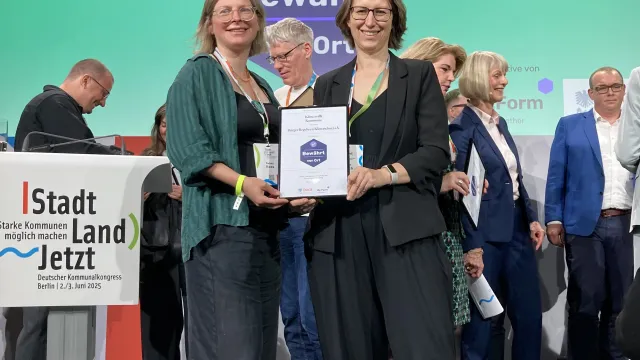
[DE Copy] Ausgezeichnet: Klima trifft Kommune erhält das Bewährt vor Ort-Siegel
Das Modellprojekt Klima trifft Kommune wurde mit dem "Bewährt vor Ort"-Siegel ausgezeichnet - in der Kategorie Klima- und Ressourcenschutz sowie Klimafolgeanpassung.
Das Projekt zeigt, wie klimapolitische Herausforderungen durch gesamtgesellschaftliche Beteiligung gemeistert werden können. Das Siegel wird vom Deutschen Städte- und Gemeindebund und Re:Form, einer Initiative von ProjectTogether, vergeben. Ausgezeichnet werden Projekte, die in der Praxis funktionieren und bundesweit als Vorbild dienen können.
News from the project
![[DE Copy] Bürgerräte_800x600](/sites/default/files/styles/bosch_4d3_medium/public/images/media/2025-04/DBT_B%C3%BCrgerrat_800x600.png.webp?h=827069f2&itok=J4qgs5EZ)
Your contacts
Dr. Gordian Haas
Senior Expert
![[DE Copy] Rabea Koss](/sites/default/files/styles/bosch_square_medium/public/images/media/2025-04/Rabea%20Koss.png.webp?h=a7e6d17b&itok=g36ViILx)
Rabea Koss
Gesellschaft für Klima und Demokratie
![[DE Copy] Steffen Krenzer](/sites/default/files/styles/bosch_square_medium/public/images/media/2025-04/Steffen%20Krenzer%202%2C%20by%20Cordula%20Kropke.png.webp?h=a7e6d17b&itok=5vPf8_iN)
[DE Copy] Steffen Krenzer
Mehr Demokratie

![[DE Copy] 099_Projektteaser_saarbrücken_manuel-frauendorf-fotografie_IMG_7053.png](/sites/default/files/styles/bosch_4d3_medium/public/images/media/2025-08/099_Projektteaser_saarbr%C3%BCcken_manuel-frauendorf-fotografie_IMG_7053.png.webp?h=827069f2&itok=3UGQSNeO)
![[DE Copy] 063_projektteaser_frankfurt_manuel-frauendorf-fotografie_IMG_4965.png](/sites/default/files/styles/bosch_4d3_medium/public/images/media/2025-08/063_projektteaser_frankfurt_manuel-frauendorf-fotografie_IMG_4965.png.webp?h=827069f2&itok=FdkpyObK)
![[DE Copy] 007_Projektteaser_zittau_dreiländereck_manuel-frauendorf-fotografie_IMG_7235.png](/sites/default/files/styles/bosch_4d3_medium/public/images/media/2025-08/007_Projektteaser_zittau_dreil%C3%A4ndereck_manuel-frauendorf-fotografie_IMG_7235.png.webp?h=827069f2&itok=ZPq9soMl)
![[DE Copy] PRIO_026_Projektteaser_emmendingen_manuel-frauendorf-fotografie.png](/sites/default/files/styles/bosch_4d3_medium/public/images/media/2025-08/PRIO_026_Projektteaser_emmendingen_manuel-frauendorf-fotografie.png.webp?h=827069f2&itok=fZ8IOXS1)
![[DE Copy] PRIO_008_Projektteaser_guben_manuel-frauendorf-fotografie_HYPERLAPSE_0300-2 (1).png](/sites/default/files/styles/bosch_4d3_medium/public/images/media/2025-08/PRIO_008_Projektteaser_guben_manuel-frauendorf-fotografie_HYPERLAPSE_0300-2%20%281%29.png.webp?h=827069f2&itok=x-wFzoh6)
![[DE Copy] PRIO_093_projekt teaser_eupen_manuel-frauendorf-fotografie_IMG_2869.png](/sites/default/files/styles/bosch_4d3_medium/public/images/media/2025-08/PRIO_093_projekt%20teaser_eupen_manuel-frauendorf-fotografie_IMG_2869.png.webp?h=827069f2&itok=SJIQdZeM)
![[DE Copy] PRIO_070_Projektteaser_agglobasel_manuel-frauendorf-fotografie_IMG_0831.png](/sites/default/files/styles/bosch_4d3_medium/public/images/media/2025-08/PRIO_070_Projektteaser_agglobasel_manuel-frauendorf-fotografie_IMG_0831.png.webp?h=827069f2&itok=CZ1HdHTU)
![[DE Copy] Projektteaser_rbs_cgr_ralingen_manuel-frauendorf-fotografie_IMG_0165.png](/sites/default/files/styles/bosch_4d3_medium/public/images/media/2025-08/Projektteaser_rbs_cgr_ralingen_manuel-frauendorf-fotografie_IMG_0165.png.webp?h=827069f2&itok=YTnG-Aqs)