At the end of a long day that had entirely revolved around death, loss, and grief, Alona Karavai was sitting in a basement bar in Kyiv. Then her phone rang with a tone she had never heard before. On the screen was a warning of a nuclear attack. The bartender called out that they were safe down there, with a generator, two sofas, and enough alcohol to last a long time. The next alert was a chemical attack, the third alarm about enemy troops in the city. Now they realized that the warning app had been hacked. And yet, in that moment, Karavai had once again experienced what the whole day had been about: When the end comes, all you have are other people.
How does a society in which loss and mortal danger are part of everyday life come to terms with death?
“We thought for a moment: Well, then we’ll just conclude the Festival of Death with a nuclear bomb,” says Karavai, laughing. And that laugh pretty much sums up the concept of the cultural festival that took place on All Saints’ Day in Kyiv, and whose conclusion they were celebrating in the basement bar. “Death frightens people,” says 43-year-old Karavai, who curated the Festival of Death, “but fear alone paralyzes, which is why we also want to make room for other emotions – grief, sorrow, curiosity, and black humor.” Through workshops, comedy performances, and Café Death, people were given a space where they could talk about the unspeakable. How does a society in which loss and mortal danger have become part and parcel of everyday life come to terms with death – and find hope? And what role can art play in this struggle for survival?
85 %
of people in Ukraine have lost someone close to them because of the war.
Since the start of the full-scale Russian invasion in February 2022, the UN monitoring mission has documented nearly 17,000 civilian deaths. And the number of victims is rising. According to a March 2026 survey by the U.S.-based NGO National Democratic Institute, 85 percent of Ukrainians reported having lost a friend, acquaintance, or family member to the war. On social media, obituaries have become the standard format. Many organizations and users no longer post black-and-white photos because everyone then thinks that someone’s died again. Alona Karavai: “I sometimes sarcastically say that we Ukrainians are death pros.”
Finding words for something there are actually no words for is a kind of lifelong theme for Karavai. She studied German Language and Literature, taught German, and in 2008 co-founded the NGO Insha Osvita, which carries out projects at the intersection of art and society. In Donetsk, she worked at the Izolyatsia Art Center until armed separatists occupied it in 2014 and turned it into a prison. She initially went to Berlin with her two-year-old daughter, but for a long time she refused to call herself a refugee
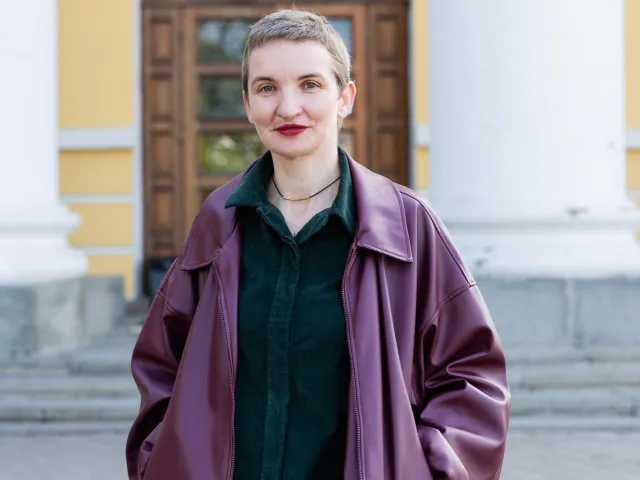
In 2024, Karavai thought it was probably the time for an exhibition about death. Shortly before that, three young artists she knew had died in the war. An artist friend sent her a link to the international Death Café movement, where strangers talk about death over tea and cake, and asked if that might be more her style than an exhibition. “He was so right!” she says today.
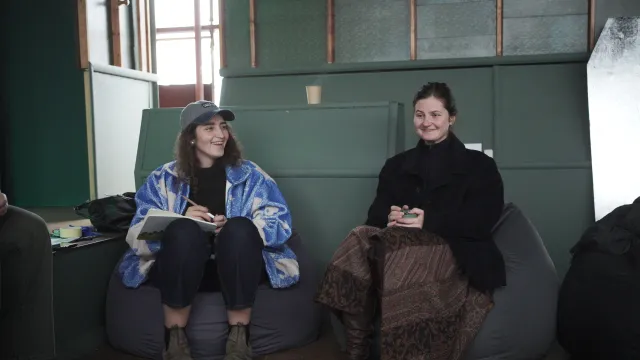
So Karavai sent out invitations via her Instagram account – Sundays in the office kitchen at Insha Osvita, when no one else was there. Coffee, cake, death. More and more people started coming and before long, what started as a private initiative became a public offering.
Café Death now takes place every few weeks, mostly in Kyiv, and occasionally in Lviv and other places in Ukraine. Some things never change. There will be hot drinks and sweet treats. Karavai often bakes cherry cake because it tastes good and looks a little like blood. People always make jokes about it, she says – it’s a good icebreaker.
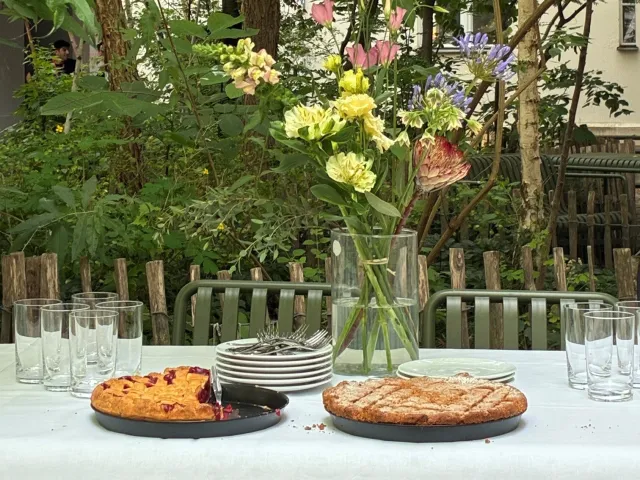
Each session begins with the same question: Why are you here? “The topic always comes from those present.” Once, two people who had just buried loved ones were sitting at a table. The others wanted to know how much a funeral costs, or whether it’s even possible to dig a grave in winter. “That put them in a different role,” Karavai says. For two hours, they weren’t the mourners around whom everyone was silent, but the experts at the table. In another session, the people who came were mourning someone they weren’t allowed to mourn publicly – a secret lover, an ex-partner. Or those who had died of cancer but are barely taken not of anymore alongside the war dead. A heroic death is just as terrible as any other, Karavai says. “Behind every loss is a single human being.” And grief is allowed to look different: “Loud, quiet, colorful or black.”
Death in Public Life
Death is very much part of public life in Ukraine. Every morning at nine o’clock, large parts of the country stand still for a minute’s silence. As of this year, this is actually enshrined in law. An online platform collects the life stories of those killed, and in cities and towns the avenues of heroes are lengthening with the growing number of the fallen.
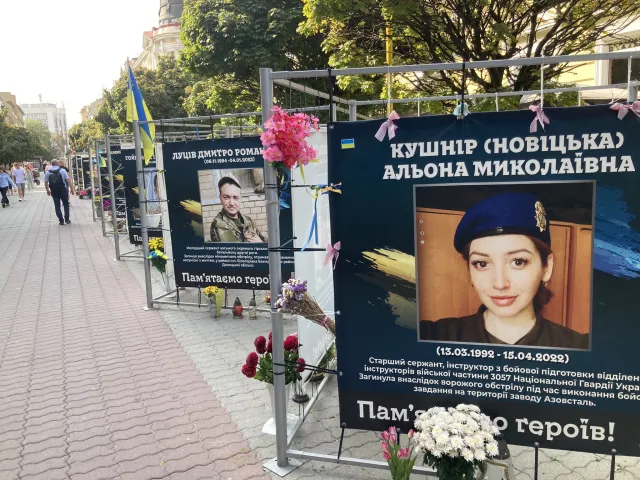
“The public authorities speak with a uniform voice,” says Karavai, and many people do not see themselves reflected in that. Among those who meet at her Café Death are people who are heading to the front the next day alongside those who have lost loved ones in the occupied territories. And that is precisely why, at the start of the fifth winter of war, this country so urgently needs culture and art. “We need gathering places where people can meet and support one another,” she says.
What Ukraine is learning through formats like Café Death could also be useful elsewhere. For individuals today who like to have everything under control, death is the ultimate affront. The historian Philippe Ariès has spoken of “forbidden death”. In June, Karavai hosted Café Death as part of the Kyiv Biennial in Berlin – once in English and once in Ukrainian. The international group included many people from Austria “who sat stiffly in their chairs and barely breathed,” she says. The following day, the Ukrainian group, who were on average much younger, “were talking about the best crematoriums in western Ukraine after just three minutes.”
If you stay silent about death, you leave the field to it. If you talk of nothing else, you’re doing that, too. Everyone in the basement bar after the Festival of Death was joking and laughing out loud following the false nuclear bomb alert. Death mustn’t have the last word. At least not until its time has come.