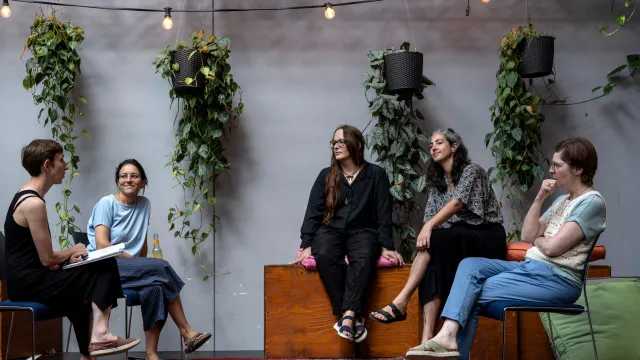
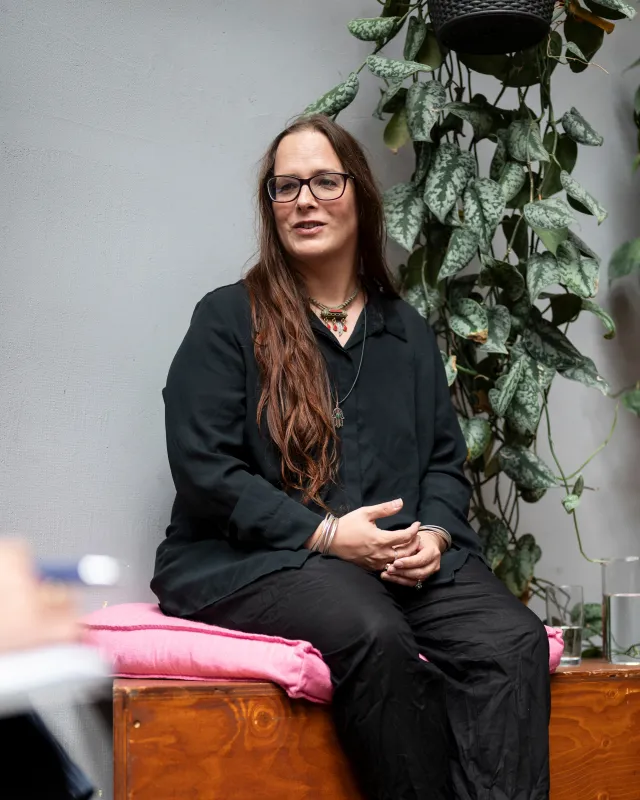
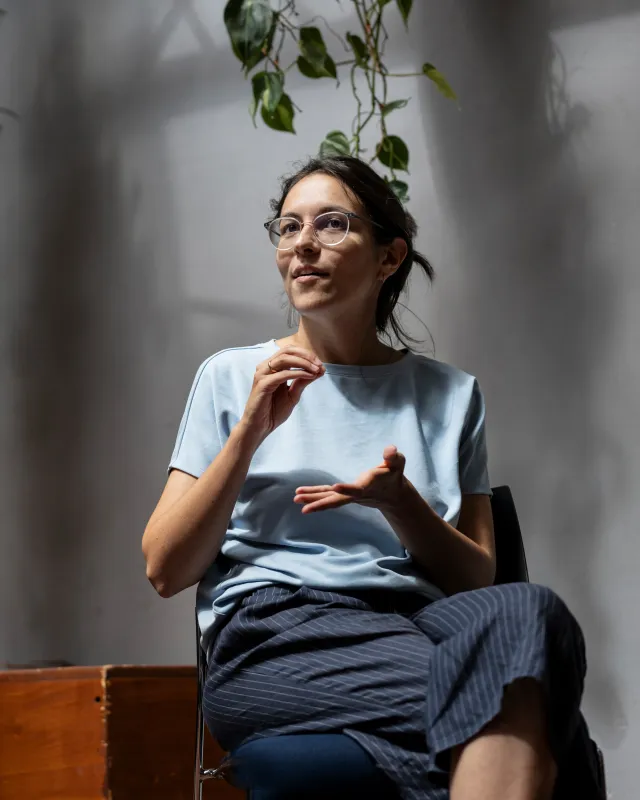
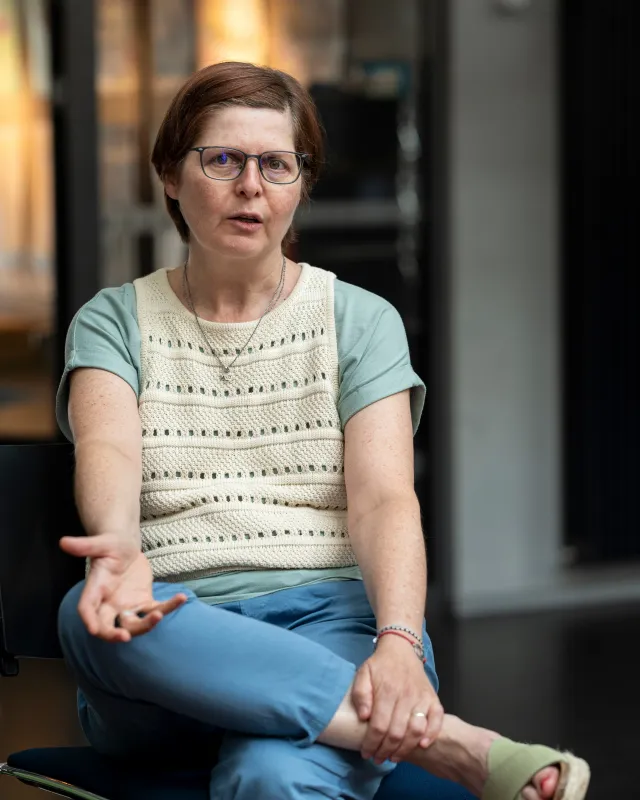
A Tuesday lunchtime in summer. The Karlstorbahnhof cultural center is located in a listed former U.S. army building in Heidelberg’s Südstadt district. We meet four women in the foyer for an interview: Yasemin Soylu and Leyla Jagiella from the Muslim Academy Heidelberg that was supported by the Robert Bosch Stiftung. Furthermore, Esther Graf from the Agency for Jewish Culture, and Sarah Ungan, our hostess from Karlstorbahnhof. They know each other well and are having a cozy chat.
The women are involved in Jewish-Muslim dialogue. Together, they are organizing the Jewish-Muslim Culture Days in Heidelberg – this year under the title “AufBruch” (New Beginning). As part of readings, concerts, and action days, artistic spaces will be opened up for Jewish, Muslim, and other post-migrant voices in order to make fractures in society visible and discussable. The Jewish-Muslim Culture Days, a unique format in Germany, were held for the first time in 2017.
The terrorist attacks by Hamas against Israel on October 7, 2023 put relations between Jews, Muslims, and other religious groups to the test. What was their experience of the events?
Leyla Jagiella: The first few days at the Muslim Academy were characterized by a great deal of speechlessness. Everyone was struggling: Should we speak out? What can we as the Muslim Academy say? When the military counterattacks came, the speechlessness grew ever greater. As a Muslim, I immediately found myself in an ambivalent situation: I was shocked by the violence in Israel and worried about Jewish friends and acquaintances. On the other hand, I knew that the Muslim communities in Germany were also under severe attack.
Esther Graf: As a conscious and active Jew, I was in shock, especially as I also have family in Israel. When Hamas declared a “Day of Wrath” around the world on Friday, October 13, I realized that it wasn’t just about Israel, it was about an all-encompassing hatred of Jews. When I realized this, it was like a second traumatization. Both my grandfathers were arrested during the November pogroms in Germany in November 1938. And now, I suddenly realized how close I was to their story. At the same time, I knew that this would be really bad for the Muslim community, that there would be hate reactions.
How did you deal with the shock?
Leyla Jagiella: At first, there were many questions: Can we still celebrate joint Jewish-Muslim cultural days during a situation like this? We have deliberately not focused on the Middle East conflict at our events so far, because we were concerned about the coexistence in Germany and the communities here in Heidelberg. We made art and culture together and were interested in current issues such as climate change. It was now clear that this was becoming more difficult.
You have carried on and given the Culture Days a new title: “AufBruch” (New Beginning). How can art help to promote dialogue?
Sarah Ungan: Art brings people together – especially across different faith communities. The shared experience – through music, dance, or visual art projects – gives rise to empowerment and self-efficacy. In our community arts projects, interested people can create art without being professional artists. It is exciting to experience how a form of vulnerability and intimacy is created that cannot be achieved through verbal dialogue alone. A good example of this is the “Under the Carpet” project. After October 7, 2023, artists and the urban community wove a carpet together on an oversize loom. They discussed the question: What is being swept under the carpet in Germany, in their own community? The weavers’ stories were woven into the carpet.
A Muslim man told me how sorry he was for what I had to go through. To this day, I still get goosebumps when I think about it.
In addition to the ongoing cultural program, you rely on a second pillar: the Community Labs. There, you facilitate constructive dialogue between the different religious communities in a protected space. How does that work?
Yasemin Soylu: We invite people from Muslim and Jewish communities to the Community Labs – and also people who feel connected to these communities. They feel able to ask questions that are not usually asked “outside.” We started with a very small group: ordinary members of the community, students, people active in Jewish-Muslim dialogue. Over time, there were more and more participants.
What do people talk about in the Community Labs?
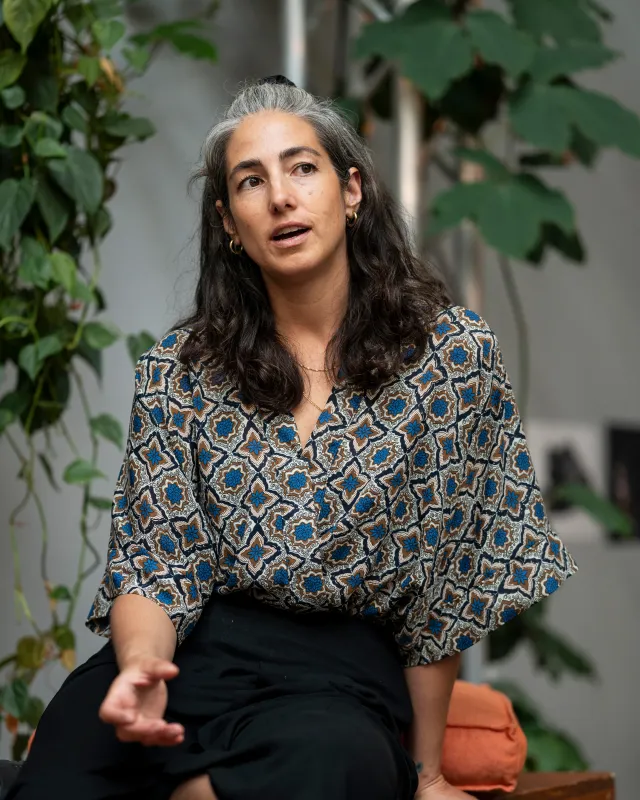
Esther Graf: The first session was at the beginning of March 2024. The moderator placed pictures on the floor: nature, landscape, flowers. An informal get-together. Then he asked us: How have you been doing since October 7? In the extremely open conversations, it quickly became clear how much we are stuck in our respective bubbles, how little we know about the other worlds. I talked about the hostility I face as a Jew. A Muslim woman told me how sorry she was for what I had to go through. To this day, I still get goosebumps when I think about it.
What has changed as a result of the dialogue in the Community Labs – and what else do you want to achieve?
Esther Graf: Recently, there was a foiled attack on the synagogue in Heidelberg. That same day, a Muslim woman from the Community Lab wrote to me, saying how bad she thought it was and that she was at a loss for words. I was very moved. We then met in private. When we see each other in the Community Lab now, it’s so different to how it was before!
Sarah Ungan: We found it much easier to speak after the first few meetings. That’s important – both professionally and privately. The Community Labs still function as a “safe space.” Sooner or later, however, we should find open formats again in which we can argue without moving away from each other. As a cultural center, we have this responsibility.
Do critical moments sometimes arise?
Esther Graf: Once, there was a young Muslim man who rather provocatively asked two students whether they didn’t have a fundamental problem with the founding of the State of Israel. I was shocked to have someone here in the Community Lab who actually questioned Israel’s right to exist. But the two young people had the patience to explain historical events. I wouldn't have been able to do that in this situation.
If we expect to be fully understood, we won’t be able to have a dialogue.
The discourse between Jews, Muslims, and the majority of society is characterized by great vulnerability. If the wrong words are spoken, it can quickly create a lot of big waves. Which mistakes are forgivable and which are not?
Esther Graf: Anti-Semitic slogans are not opinions. I don’t have to put up with that. I don’t want that here, nor do I want any anti-Muslim remarks.
Yasemin Soylu: Fortunately, we have not yet experienced this at our events. Otherwise, I think that if we expect to be fully understood, we won’t be able to have a dialogue. It’s more about learning to share a cultural space, a city, a stage – even if people have opposing positions.
One of your action days is called “Dreaming Jewish-Muslim Futures.” What is your dream for the Jewish-Muslim dialogue of the future?
Yasemin Soylu: Many people say that Jewish-Muslim dialogue is dead, including those who have been active in Jewish-Muslim dialogue for decades. I hope that we reach a point where we experience the current challenges as strengthening the dialogue, not weakening it.