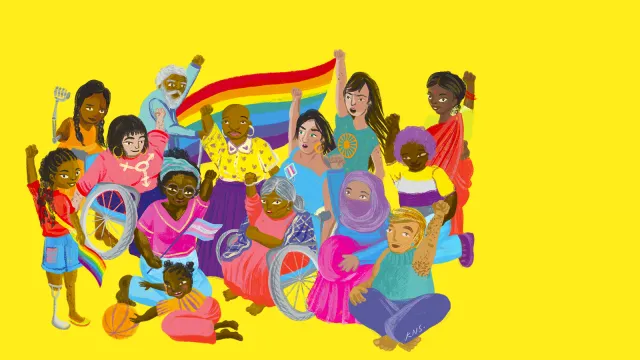
Eleven completely different organizations from around the world, funded by the Robert Bosch Stiftung to explore intersectionality in practice and to exchange ideas on a regular basis: this was the concept for the Support Program "Reducing Inequalities through Intersectional Practice" that started in 2020. Partner organizations working on different aspects of inequality and with different approaches received funding to explore and deepen their intersectional practices. In a year-long facilitated and co-designed learning format partners were invited to share issues and challenges they encountered when working with an intersectional approach.

“Intersectionality is key to understanding and tackling inequality in all its complexities. For us as funders, that means we need to listen, learn, improve, accept to fail – and do it better.”
With the program having ended, an e-booklet was created to explore “The Transformative Power of Intersectionality”. In several interviews and contributions, it offers insights into the intersectional practices of partners and the reflections, insights and demands that emerged from the program. With this publication, the Robert Bosch Stiftung wants to increase visibility for successful intersectional approaches in social change work and contribute to the widespread application of intersectionality in practice.
FAQ INTERSECTIONALITY
What is intersectionality?
Intersectionality describes the interplay of different forms of discrimination which produces distinct experiences of inequality. In addition to gender and race, other relevant characteristics include class, disability, religion, sexual orientation, age and nationality, among others. Through the concept of intersectionality, the role, function and impact of power structures become evident, making visible the concrete effects that privilege and discrimination have on different groups and individuals. An intersectional perspective can be used to draw attention to existing systems of oppression in society and to challenge, break through and change them.
Where does intersectionality come from?
The term "intersectionality" (from the English word "intersection") was coined by Black feminist scholar Kimberlé Crenshaw to describe the particular experiences of discrimination faced by African American women who are marginalized because of both their race and their gender. The word was first used then, but the concept was already circulating in Black feminist spaces before Crenshaw's essay. One of the most notable examples is the work of the Combahee River Collective.
Why is intersectionality important?
Intersectionality offers a transformative approach to understanding how inequalities are experienced, particularly for individuals or groups who face multiple forms of disadvantage. Intersectional approaches draw attention to interrelated forms of discrimination, making it possible to analyze and address the root causes of inequality. Intersectionality thus holds the potential for promoting social justice, solidarity and fairness.
What does applying intersectionality look like in practice, promoting social justice and reducing inequality?
Inequality is complex and multi-dimensional. It cannot be fully understood by looking at one aspect of inequality in isolation from others. Similarly, potential solutions must be designed in a way that takes into account the intersections of different forms of inequality. The intersectional approach makes it possible to view inequality in all its complexity and to recognize its roots in systems of oppression. This is why participatory processes of co-creation, collective analysis, and movement building led by people with lived experiences of discrimination are essential building blocks for collective action to reduce inequality. To advance the agency of those who are marginalized, power must be redefined and redistributed – who makes the decisions and how are they being made? Intersectional practice therefore must include honest reflection and accountability on one's own privileges and advantages to take concrete and durable steps to ensure that power is distributed equitably.

![[DE Copy] Intersectional_Principles_Teaser](/sites/default/files/styles/bosch_3d2_small/public/images/media/2023-02/Intersectionality%20Principles_Webmagazin-Zuschnitt_800x600px-Kruthika_NS.jpg.webp?h=d29a8858&itok=uy2-yRKl)