Image
Cover Sonderauswertung Vielfaltsbarometer_600x800.png
Download PDF

Participation and Belonging in Germany’s Immigration Society – Key Findings in Brief

Teilhabe und Zugehörigkeit in der Einwanderungsgesellschaft
2025
Teilhabe und Zugehörigkeit in der Einwanderungsgesellschaft

Germany is an immigration country and is therefore characterized by ethnic and religious diversity. However, acceptance of diverse ethnic backgrounds and religions has sharply declined in recent years, according to the Diversity Barometer 2025. While 78 % of respondents in 2019 reported that they always learned something new when spending time with people from other countries, only 54 % feel this way now. Additionally, 59 % currently believe that nowadays one could be “labeled as racist for the slightest thing”. 

Under these circumstances, how can we enable participation and belonging in an immigration society for as many as possible? How do people living in Germany – those with and without a migration background – view the different aspects of diversity? What are the foundations of togetherness? The present focus report, “Participation and Belonging in Germany’s Immigration Society”, from the Diversity Barometer 2025 by the Robert Bosch Stiftung, offers answers to these questions.

Robert Bosch Stiftung

Authors

Regina Arant, Georgi Dragolov, Klaus Boehnke, Ferdinand Mirbach

No Longer at the Limit: Why the Situation of Municipalities in Refugee Reception Remains Challenging (Report in German)

Programm- und Projektbroschüren
2025
Nicht mehr am Limit: Warum die Lage der Kommunen bei der Flüchtlingsaufnahme dennoch herausfordernd bleibt

The expertise examines how the accommodation situation for refugees in Germany has developed since the high arrival numbers in 2022 and 2023. The study shows that while acute overload has eased in many places, the task remains challenging for municipalities. Based on a nationwide survey of 894 municipalities, it becomes clear how structural problems—from the lack of affordable housing to bottlenecks in immigration authorities—complicate integration. The analysis highlights how political measures take effect and what consequences they have for administration and refugees.

You can find the article on the expertise here: https://mediendienst-integration.de/artikel/viele-kommunen-sind-nicht-mehr-am-limit.html

Robert Bosch Stiftung

Authors

Boris Kühn, Julian Schlicht

Image
Cover Vielfaltsbarometer 2025_600x800.png
Download PDF

The Diversity Barometer 2025 – Key Findings in Brief

Zentrale Publikationen
2025
Das Vielfaltsbarometer 2025

The Diversity Barometer of the Robert Bosch Stiftung is a representative survey on social diversity and cohesion in Germany. It provides data on attitudes toward the following dimensions of diversity: age, gender, disability, sexual orientation, low socioeconomic standing, ethnic origin, and religion. For the 2025 Diversity Barometer, around 4,800 German-speaking individuals aged 16 and older were surveyed online. The results are compared with those of the 2019 Diversity Barometer. The study was designed and analyzed by Constructor University Bremen. Among the authors is Dr. Ferdinand Mirbach, Senior Expert and Diversity Officer at the Robert Bosch Stiftung.

This is a fact sheet with the key findings of the survey in brief.

You can find the complete report here (in German).

Robert Bosch Stiftung

Authors

Regina Arant, Georgi Dragolov, Klaus Boehnke, Ferdinand Mirbach

A LEVEL up! for Support Programs

Programm- und Projektbroschüren
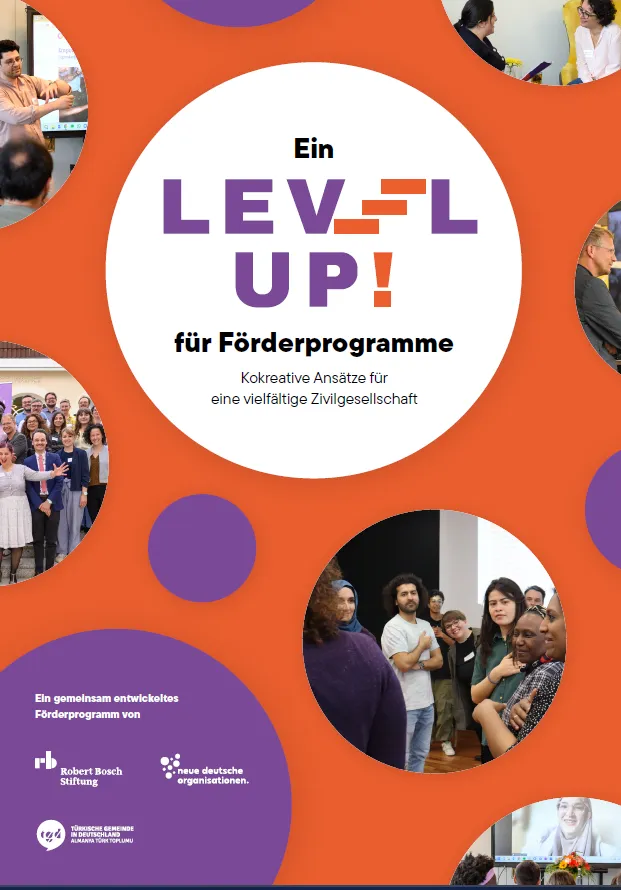
Ein LEVEL up! für Förderprogramme

Developing projects together and promoting them with confidence—that is the idea behind LEVEL up!, a support program run by the Turkish Community in Germany (TGD), the new German organizations (ndo), and the Robert Bosch Foundation. How can cooperation between migrant, Jewish, Muslim, and new German organizations succeed? And what can funding institutions do to support these organizations in their work? These questions were discussed at the LEVEL up! conference with representatives from civil society, academia, politics, and philanthropy. The brochure summarizes the most important findings and introduces the program and its partners. In German.

Robert Bosch Stiftung, Türkische Gemeinde in Deutschland (TGD), neue deutsche organisationen (ndo)

Authors

Anna Friedrich, Jasmin Azar, Volker Nüske

Image
Cover-Repchance-Spain-600x800.png
Download PDF

REPCHANCE Spain

REPCHANCE Spain (Englisch)
2025
REPCHANCE Spain (Englisch)

The project REPCHANCE Spain assesses the current state of inclusion in the political sphere of citizens of migrant origin, which includes individuals whose or parents migrated to one of in these two countries, offering a longitudinal perspective of trends over time. Undertaken within the context of the international collaborative project REPCHANCE Europe, it allows understanding the similarities and differences in the social and political dynamics that foster the incorporation of people from a diverse range of backgrounds into elected political office.

Robert Bosch Stiftung

Authors

Laura Morales and Carles Pamies

Integration without Identification?

Integration without Identification?

As Kenya embraces digital identity solutions, are refugees and migrants being left behind? In their new report our partners at Caribou Digital analyze historical and current challenges faced by foreign nationals in accessing identification documents, both physical and digital. Read how these legal and bureaucratic barriers impact integration and access to essential services and discover the possibilities for a more inclusive and sustainable approach to refugee integration in Kenya and beyond. A must-read for anyone interested in equitable access in a digital age.

Caribou Digital

Authors

Keren Weitzberg, Saada Loo, Asha Jaffar