Image
SVR-Policy_Brief_Cover_600x848px.png
Download PDF

A life without passport

2023

A growing number of people in Germany are stateless or have undetermined nationality. As a result, their social participation is in part severely restricted. This policy brief provides an up-to-date overview of the situation of stateless people in Germany. In addition to an analysis of the socio-demographic composition of this population group and their legal status, the paper also contains recommendations for policymakers. 

The analysis is part of a research project conducted by the Expert Council on Integration and Migration and funded by the Robert Bosch Stiftung. The goal of the project is to examine the challenges of statelessness in Germany, raise awareness of the issue of statelessness, and develop recommendations for action to better deal with the phenomenon in politics and administration.

Sachverständigenrat für Integration und Migration

Your contacts

Image
Volker_Nueske.png

Volker Nüske

Senior Projektmanager

Image
Christine Prokop_800x800.jpg

Dr. Christine Prokop

Geschäftsführerin

Lokalprojekte

Image
Romy Marquart_800x800.jpg

Romy Marquart

Projektmanagerin

Lokalprojekte

Image
Joscha Wendland

Joscha Wendland

Projektmanager

Robert Bosch Stiftung

Image
Porträt Dustin Savarino_800x800.png

Dustin Savarino

Image
Porträt Carolina Leersch_800x800.jpg

Carolina Leersch

this project

Similar Projects

Image
publikation external cover
Download PDF

External Processing

2023

Access to territorial asylum is under significant pressure in many corners of the world. Pushbacks at borders as well as pandemic-era mobility restrictions have prevented many asylum seekers from reaching their destinations. And new and ongoing crises, including those in Afghanistan and Ukraine, have highlighted the need to offer protection closer to where vulnerable populations live, and for high-income countries to find ways to share responsibilities with the low- and middle-income countries that host the overwhelming majority of people in need of international protection.


This has led to renewed interest in external processing, which involves conducting part or all of the asylum procedure outside a destination country’s territory. Notably, even as countries such as Australia and the United Kingdom have adopted policies to offshore asylum processing to countries such as Papua New Guinea and Rwanda in hopes of deterring spontaneous arrivals, there is growing interest in using external processing in ways that complement existing territorial asylum and expand, rather than restrict, protection opportunities.


This report — part of the Beyond Territorial Asylum: Making Protection Work in a Bordered World initiative led by the Migration Policy Institute and the Robert Bosch Stiftung — highlights the opportunities that external processing offers as well as the challenges to its implementation and the risks it could pose to territorial asylum. It explores three categories of external processing policies implemented or proposed to date: humanitarian visas, emergency evacuations, and external processing centers. The report also identifies key conditions that must be present for external processing to occur in a protection-sensitive manner.
Migration Policy Institute

Authors

Pauline Endres de Oliveira, Nikolas Feith Tan

Decentralizing digital documentation

2023

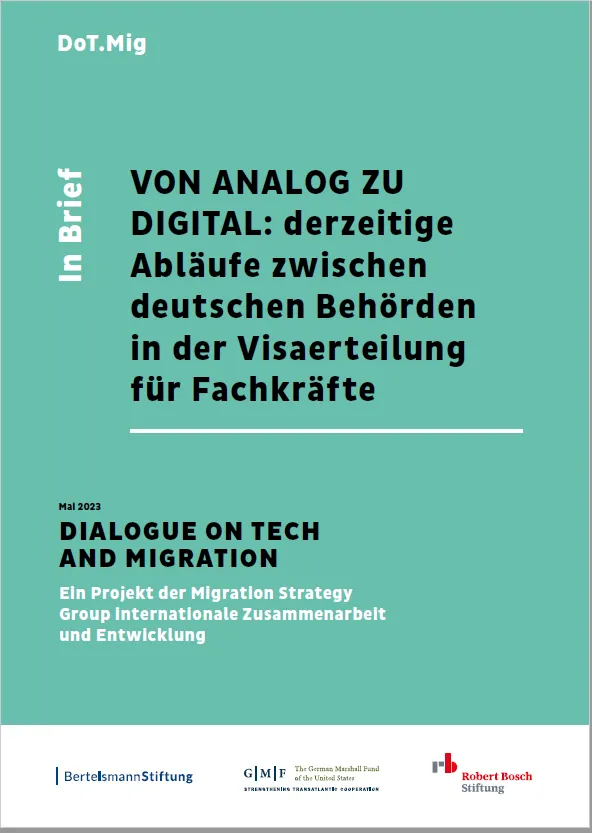
Reliable identification documents are at the core of migration or mobility management. But insufficient systems for digital identification and limited documentation are common obstacles in the administrative process. Identity data of migrants and refugees is also often shared without their knowledge or consent. Decentralized and user-centric approaches based on the principle of self-sovereign identity (SSI) can offer a way out. SSI based solutions promise to empower the individual and enhance the administrative process. In this brief, Michael Kolain explains what SSI solutions have to offer compared to conventional forms of digital identification instruments and what challenges need to be addressed to establish an SSI ecosystem. The publication is part of the "Dialogue on Tech and Migration, DoT.Mig." of the Migration Strategy Group, a joint initiative of the Robert Bosch Stiftung, the Bertelsmann Stiftung and the German Marshall Fund.

Robert Bosch Stiftung, Bertelsmann Stiftung und German Marshall Fund (Hg.)

Authors

Michael Kolain

More Connected, Less Protected?

With its European Interoperability Framework (EIF) adopted in 2019, the European Union seeks to expand the interoperability of various databases, particularly those of administrations and border systems. The interconnection project also affects databases that have not been linked before and that contain information on migration, asylum and crime, and provides for a person-based centralized search and filter function. In this briefing, Alberto Tagliapietra provides background information on interoperability and the status of the EU project, and asks what consequences the project has for individual mobility and digital rights in the EU and at its borders. The publication is part of the "Dialogue on Tech and Migration, DoT.Mig." of the Migration Strategy Group, a joint initiative of the Robert Bosch Stiftung, the Bertelsmann Stiftung and the German Marshall Fund.

Robert Bosch Stiftung, Bertelsmann Stiftung und German Marshall Fund (Hg.)

Authors

Alberto Tagliapietra