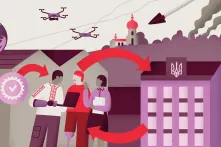
One in two teachers in Germany already has Ukrainian children and young people at their school. However, for the vast majority of teachers (92 percent), accommodating refugee students is currently not their biggest challenge. Instead, even in the third year of the pandemic, 38 percent of respondents still see COVID-19 measures, the additional workload they entail and the resulting difficulties in planning as the greatest burden in their day-to-day work.
Teacher shortages rank second, cited by 26 percent of respondents as their biggest challenge, followed by student behaviour (21 percent) and digitalisation (17 percent).
These are the findings of the German School Barometer Special, a representative survey commissioned by the Robert Bosch Stiftung GmbH and conducted by forsa. Around 1,000 teachers at general and vocational schools were surveyed in early April 2022.

Around three quarters of the teachers surveyed report that refugee children are taught at least partly in mainstream classes alongside students from Germany. Teaching in students’ native language or subject-specific lessons in Ukrainian currently play virtually no role in schools. In-person teaching by Ukrainian staff and online lessons are each mentioned by only 1 percent of respondents. Digital learning resources in Ukrainian could, however, be put to use: 75 percent of respondents say their school has digital devices that could be made available to refugee students at short notice.


“We should therefore make it possible for Ukrainian staff to work in German schools quickly and with minimal bureaucracy, including through cooperation between civil society organisations and public authorities.”