The Diversity Barometer of Robert Bosch Stiftung
About the Project
Germany is a diverse country. This presents opportunities for future development in a globalized world, but also challenges for how people live together. At present, it seems that many people perceive the challenges more than the opportunities. Increasing social diversity is just one issue among many that contribute to a sense of fatigue or even overwhelm: wars and conflicts, climate change, the impacts of the COVID-19 pandemic, refugee movements, and economic recession. Each of these challenges is significant on its own, yet in recent years they have emerged almost simultaneously and have reinforced one another.
Against this backdrop, social change is increasingly perceived as an additional burden. And these changes are manifold: demographic shifts are progressing noticeably. Growing income inequality is causing major problems, and distributional conflicts are intensifying. Ongoing immigration from around the world is leading to greater linguistic, cultural, and religious diversity. At the same time, German society is undergoing a process of pluralization and individualization, in which formerly marginalized groups – such as queer individuals – are becoming more central to public discourse.
So what is the connection between diversity and social cohesion? How do people in Germany interact with others of different ages or genders, with those who are socially disadvantaged or disabled, and with the diversity of sexual orientations, ethnic backgrounds, and religions? And how can acceptance of diversity be strengthened? With the Diversity Barometer study, we aim to find answers to these questions.


On the Diversity Barometer Survey
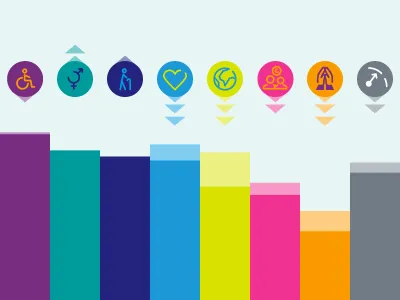
The Diversity Barometer of the Robert Bosch Stiftung is a representative survey on social diversity and coexistence in Germany. It provides data on respondents’ views regarding various dimensions of diversity: age, gender, disability, sexual orientation, socio-economic weakness, ethnic background, and religion. The data collected through the Diversity Barometer is also compiled into an overall Diversity Index, which indicates the level of acceptance of diversity at both the national and federal state levels.
Why do we publish the Diversity Barometer?
With this project, we aim to contribute to a more objective and fact-based discussion on social diversity, which is often emotionally charged. To this end, we not only collect data through a representative population survey, but also offer recommendations on how to shape coexistence in a diverse society, reduce discrimination, and improve mutual understanding. All of these are essential conditions for strengthening social cohesion and enhancing society’s resilience in the face of global challenges.
When was the Diversity Barometer first introduced?
The study was first conducted in 2018 and published as the Diversity Barometer in 2019. At that time, around 2,940 individuals were interviewed via a representative telephone survey. For the most recent survey in 2025, nearly 4,800 German-speaking individuals aged 16 and older were surveyed online. Thanks to applied weighting methods, the data from both years are comparable. The study was designed and the data analyzed by the research team at Constructor University Bremen.
News from the project
![[DE Copy] Projekt Yallah_Werkstatt_800x600.jpg](/sites/default/files/styles/bosch_4d3_medium/public/images/media/2026-02/Projekt%20Yallah_Werkstatt_800x600.jpg.webp?h=fe48e0cc&itok=xvj9xk6T)
![[DE Copy] Vielfaltsbarometer 2025_Demokratie_teaser_imago826811224.jpg](/sites/default/files/styles/bosch_4d3_medium/public/images/media/2026-01/Vielfaltsbarometer%202025_Demokratie_teaser_imago826811224.jpg.webp?h=827069f2&itok=zlHWMvBM)

Your contacts

Dr. Ferdinand Mirbach
Senior Expert

![[DE Copy] 099_Projektteaser_saarbrücken_manuel-frauendorf-fotografie_IMG_7053.png](/sites/default/files/styles/bosch_4d3_medium/public/images/media/2025-08/099_Projektteaser_saarbr%C3%BCcken_manuel-frauendorf-fotografie_IMG_7053.png.webp?h=827069f2&itok=3UGQSNeO)
![[DE Copy] 063_projektteaser_frankfurt_manuel-frauendorf-fotografie_IMG_4965.png](/sites/default/files/styles/bosch_4d3_medium/public/images/media/2025-08/063_projektteaser_frankfurt_manuel-frauendorf-fotografie_IMG_4965.png.webp?h=827069f2&itok=FdkpyObK)
![[DE Copy] 007_Projektteaser_zittau_dreiländereck_manuel-frauendorf-fotografie_IMG_7235.png](/sites/default/files/styles/bosch_4d3_medium/public/images/media/2025-08/007_Projektteaser_zittau_dreil%C3%A4ndereck_manuel-frauendorf-fotografie_IMG_7235.png.webp?h=827069f2&itok=ZPq9soMl)
![[DE Copy] PRIO_026_Projektteaser_emmendingen_manuel-frauendorf-fotografie.png](/sites/default/files/styles/bosch_4d3_medium/public/images/media/2025-08/PRIO_026_Projektteaser_emmendingen_manuel-frauendorf-fotografie.png.webp?h=827069f2&itok=fZ8IOXS1)
![[DE Copy] PRIO_008_Projektteaser_guben_manuel-frauendorf-fotografie_HYPERLAPSE_0300-2 (1).png](/sites/default/files/styles/bosch_4d3_medium/public/images/media/2025-08/PRIO_008_Projektteaser_guben_manuel-frauendorf-fotografie_HYPERLAPSE_0300-2%20%281%29.png.webp?h=827069f2&itok=x-wFzoh6)
![[DE Copy] PRIO_093_projekt teaser_eupen_manuel-frauendorf-fotografie_IMG_2869.png](/sites/default/files/styles/bosch_4d3_medium/public/images/media/2025-08/PRIO_093_projekt%20teaser_eupen_manuel-frauendorf-fotografie_IMG_2869.png.webp?h=827069f2&itok=SJIQdZeM)
![[DE Copy] PRIO_070_Projektteaser_agglobasel_manuel-frauendorf-fotografie_IMG_0831.png](/sites/default/files/styles/bosch_4d3_medium/public/images/media/2025-08/PRIO_070_Projektteaser_agglobasel_manuel-frauendorf-fotografie_IMG_0831.png.webp?h=827069f2&itok=CZ1HdHTU)
![[DE Copy] Projektteaser_rbs_cgr_ralingen_manuel-frauendorf-fotografie_IMG_0165.png](/sites/default/files/styles/bosch_4d3_medium/public/images/media/2025-08/Projektteaser_rbs_cgr_ralingen_manuel-frauendorf-fotografie_IMG_0165.png.webp?h=827069f2&itok=YTnG-Aqs)