The Robert Bosch Stiftung has been engaged in Eastern Europe for decades. Why is this commitment so important to the Foundation?
Bernhard Straub: Promoting international understanding, peace, and social cohesion has always been at the heart of the Robert Bosch Stiftung’s mission. In this way, we continue the legacy of our founder, Robert Bosch, who was deeply committed to a united and peaceful Europe. He expressed this conviction succinctly: “Only mutual understanding can create a tolerable relationship.”
The Foundation began supporting German-Polish relations as early as the 1970s. At the time, direct encounters across the Iron Curtain were far from commonplace. After the end of the Cold War, the Foundation expanded its work throughout Central and Southeastern Europe as well as the successor states of the former Soviet Union, with Russia and Ukraine becoming particular focal points.
When Russia launched its full-scale invasion of Ukraine in 2022, it quickly became clear to us that we needed to support our current and former partners in Ukraine. This is not only about helping people through an acute crisis. It is also about ensuring that a free and democratic society can endure under wartime conditions and shape its own future.
What role do the Foundation’s long-standing experience and networks in the region play?
Bernhard Straub: We have been connected to Central and Eastern Europe for many decades. From the mid-1990s well into the 2010s, we supported programs centered on personal encounters, particularly among young people. These efforts gave rise to networks and partnerships that remain strong today.
One example is the Theodor Heuss College, through which the Foundation supported young people’s civic engagement. Programs such as the Theodor Heuss College later became formative for our work across Central and Eastern Europe. MitOst also emerged from the Foundation’s earlier activities. Founded by former Foundation fellows, the organization now connects people from numerous countries and is an important partner in our support for Ukraine. Former participants from Central and Eastern Europe also make up the largest group within the Bosch Alumni Network and remain connected to the Foundation through our International Alumni Center.
Such long-term relationships create trust. They help us, together with our partners, assess developments realistically and design support approaches tailored to local circumstances.
In 2024, the Foundation established a dedicated Ukraine unit. How has its support evolved since the beginning of the war?
Bernhard Straub: Immediately after the invasion, the focus was on rapid and unbureaucratic emergency assistance. Many of our partners found themselves in an existential crisis. At the same time, it quickly became clear that Ukraine needs not only short-term aid but also reliable, long-term prospects.
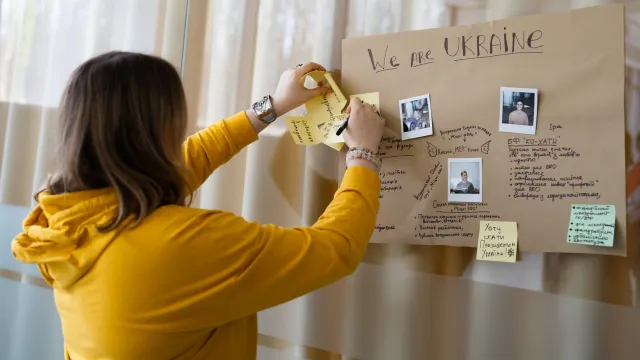
That is why we strategically expanded our engagement. Today, we work primarily with organizations from Ukrainian civil society. They are a key factor in strengthening societal resilience and are driving forces for change, despite operating under immense pressure. We support them in remaining capable of action even under extreme conditions. We also advocate for their experiences and perspectives to be taken into account in the country’s reconstruction process.
One important lesson is that societal resilience is not created through infrastructure or financial resources alone. Resilience requires effective institutions, mutual trust, and people willing to take responsibility. That is precisely where our support is focused.
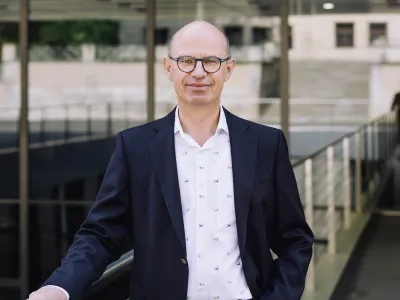
“Our goal is a Ukraine that emerges from the war not only physically rebuilt, but also strengthened democratically, socially, and institutionally.”
In July 2026, Russia designated the Robert Bosch Stiftung an “undesirable organization”. How do you assess this decision?
Bernhard Straub: Naturally, we regret this decision. It reflects the increasing restrictions on civil society in Russia and demonstrates how difficult independent international cooperation has become. Even before the Russian government’s decision, it had become highly risky and, under the prevailing conditions, nearly impossible for civil society actors in Russia to engage with us. The designation also reflects a political environment in which support for independent civil society work is increasingly perceived as a threat and actively suppressed.
However, this designation does not change our fundamental convictions. Especially when political tensions rise and the space for independent voices shrinks, these efforts remain essential.
The Foundation has not been active in Russia since the end of 2020. However, we continued our involvement in the German-Russian Youth Exchange Foundation until the end of 2024. Like the youth exchange program, initiatives such as the Robert Bosch Lectureship Program, support for town-twinning conferences, and the Cultural Managers Program were designed to foster professional, cultural, and societal exchange. They pursued no political agenda and were not directed against Russia or its people. On the contrary, they served the purpose of fostering understanding between Germans and Russians.
Russian state media have disseminated false claims about the Robert Bosch Stiftung. How do you respond to such portrayals?
Bernhard Straub: For more than sixty years, the Robert Bosch Stiftung has promoted understanding and exchange between people through its charitable, independent, and nonpartisan funding activities. Our work has always been aimed at strengthening dialogue, education, culture, science, and civic engagement. It is not directed against the people of Russia or against the Russian state. The Robert Bosch Stiftung has never supported military activities or armed conflict, and it does not do so today.
All of our activities in Central and Eastern Europe have been geared toward exchange and mutual understanding. To provide a few examples from Russia: Over two decades of intensive engagement, we founded and supported the German-Russian Youth Exchange Foundation through a public-private partnership with Germany’s Federal Ministry for Family Affairs, Senior Citizens, Women and Youth, the City of Hamburg, and the Eastern Committee of German Business. We enabled young people from Germany to teach German at universities across Russia. We also supported cultural exchange between Germany and Russia, as well as translations of Russian literature.
In 2012, the Russian parliament adopted a law classifying organizations that receive funding from abroad as “foreign agents” and subjecting them to extensive government restrictions. This eventually made cooperation with our partners on the ground almost impossible.
Our engagement in Russia ended in 2020. At that time, we fundamentally reoriented our international work around thematic priorities and phased out our previous regional focus areas. Within these thematic priorities, we remain active in a small number of Central and Eastern European countries, including Poland, where we work with partners to advance shared goals in areas such as regenerative land use and climate protection.
What goals does the Foundation pursue with its engagement in Ukraine over the coming years?
Bernhard Straub: With the €20 million available to us through the end of 2028, we aim to strengthen Ukrainian civil society over the long term and ensure that it plays a central role in rebuilding the country. This reconstruction will require the renewal of all areas of society, in line with the principle of “Build Back Better.” Civil society is already contributing significantly to social cohesion and the country’s resilience by assuming responsibilities that would otherwise fall to the state.
To this end, we support local organizations such as community foundations in contributing to food security through civic engagement. We identify new financing approaches to make organizations more independent and help innovative organizations take the next step in their development. Through our funding, we provide the space needed for Ukrainian courage and innovation to thrive, even when this means taking risks.
We also bring Ukrainian perspectives into international debates, for example at the Munich Security Conference. In addition, we connect philanthropic organizations in the Foundations for Ukraine network so they can share knowledge, better coordinate their activities, and use existing resources more effectively. This has led to collaborations such as a joint international foundations fund for Mental Health, which was established with initial capital of nearly €3 million.
Our goal is a Ukraine that emerges from the war not only physically rebuilt, but also strengthened democratically, socially, and institutionally. We seek to contribute to that goal together with our partners.
Despite the ongoing challenges, what gives you hope?
Bernhard Straub: I am inspired by the determination of our partners in Ukraine. Despite war, uncertainty, and personal hardship, they remain committed to education, culture, social inclusion, and democratic development.
Their actions demonstrate what civil society truly means: taking responsibility for others and helping shape the common good under any circumstances. As long as people remain willing to do that, there is a foundation for peace, cohesion, freedom, and a shared future.
Interview conducted by Stefanie Kaufmann Dimeski.

![[DE Copy] Integration_Weltküche_Frau und Mädchen_800x600.jpg](/sites/default/files/styles/bosch_3d2_small/public/images/media/2026-05/Integration_Weltk%C3%BCche_Frau%20und%20M%C3%A4dchen_800x600.jpg.webp?h=d7a056e9&itok=tGc7Wqj0)