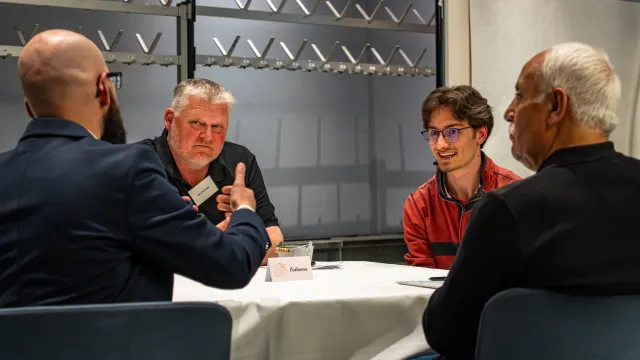
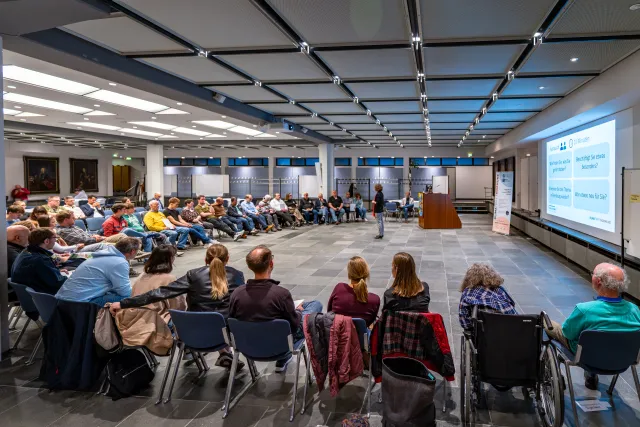
Lars Sonntag stands alone at a round table in the basement of Flensburg City Hall, unscrewing the cap of a small bottle of water. He has arrived a little early. The room is still mostly empty, vast as a swimming pool and supported by heavy concrete beams. Dozens of small lights glow from the high ceiling. At the far end, thirty chairs have been arranged in a semicircle. As Sonntag takes a sip of water, a man and a woman join him, car drivers like him. They chat about traffic jams and the struggle to find parking.
Three months earlier, Sonntag had received a letter from the City of Flensburg. “At first, I thought I’d been caught speeding,” he recalls. Instead, it was an invitation to take part in a citizens’ assembly. Would he be willing to spend four weekends in April and May 2026 meeting with 29 other residents to discuss the city’s transport situation? The group, the letter explained, would develop concrete recommendations for local policymakers, following a decision by Flensburg’s city council. Similar invitations had been sent to 1,500 randomly selected residents.
Citizens’ Assemblies Explained
What Does a Citizens’ Assembly Do?
Citizens’ assemblies bring together randomly selected members of the public to discuss a political issue in a professionally facilitated process and develop joint recommendations for policymakers. Random selection is intended to ensure that people from all parts of society are represented, rather than allowing only the loudest voices at the margins of public debate to be heard.
How Are Citizens Chosen for a Citizens’ Assembly?
For the citizens’ assembly featured in this report, the City of Flensburg contacted 1,500 residents selected at random, using neighbourhood, age and gender as initial criteria. In a second step, those who responded were weighted according to factors such as mobility habits, educational background and migration history. Thirty participants were then chosen by lot to reflect Flensburg’s demographic makeup as closely as possible. Residents who had not responded after three weeks were even contacted personally and encouraged to take part.
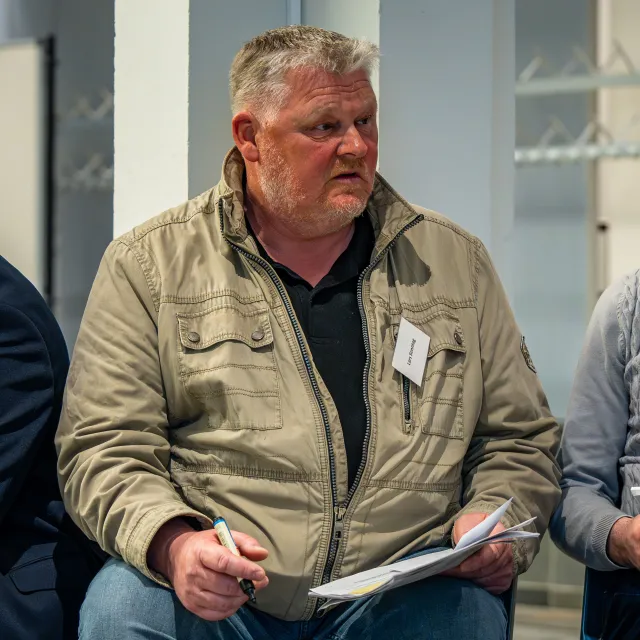
Sonntag is 53 years old, works as a crane operator, is married and has two grown-up children. Like many of the other participants selected by lot, he had little previous involvement in politics. “Once or twice, I considered getting involved in politics,” he says. “But those were just pipe dreams. I’m not cut out for it.”
The idea of joining a citizens’ assembly, however, immediately appealed to him. “It was cool that they reached out to me about it,” he recalls. He accepted right away, replying by email.
Citizens’ assemblies and similar forms of deliberative, lottery-based public participation have existed in Germany since 1972. Over the years, they have taken different forms and names, including citizens’ assemblies, planning cells, citizens’ dialogues and citizens’ forums. Yet they have often shared a common weakness. “Too often, good recommendations end up sitting in a drawer,” says Gordian Haas, who oversees the topic for the Robert Bosch Stiftung. The foundation supports Climate Meets Local Government, the initiative behind the citizens’ assembly in Flensburg as well as in three others in municipalities across Germany.
“The Flensburg citizens’ assembly introduces an important innovation,” Haas explains. Once the process is complete, a local referendum will be held in 2027, allowing all eligible voters to decide whether selected recommendations from the assembly should be implemented. If approved, the measures will be translated into binding local legislation. The aim, then, is for the citizens’ assembly to lead to tangible political outcomes.
The Participants: “A Snapshot of Society”
By now, the large room in City Hall has filled up. The day’s topic is how to deal with competing demands for space from pedestrians, cyclists, public transport users and motorists. Milen Steensen is also waiting for the session to begin.
“It’s going to be interesting,” says the 25-year-old student teacher. “There’s a real mix of people here, a genuine cross-section of society.” She arrived on foot and explains that cycling and walking are among her main ways of getting around the city.
At ten o’clock, the participants take their seats in the semicircle. Four facilitators introduce themselves, followed by a presentation on the state of the mobility transition. Then the members of the citizens’ assembly are invited to pick a piece of candy from a basket.
“This is how we’ll assign you to your working groups,” one of the facilitators explains. Five flavours, five small groups. “All the cherry sweets over here, please!” someone calls from the back of the room.
Sonntag’s Colleagues Were Skeptical: “It’s Just About Cyclists”
A short while later, Lars Sonntag is seated at the “lemon” table with four other participants. In front of them lies a map of the city centre. Their task is to agree on the three issues they consider most important.
“I worry that I won’t be able to get to my doctor anymore if the city centre becomes car-free,” says Sonntag. “The bus isn’t always on time.”
A cyclist sitting next to him responds directly. “As a driver, you’re part of the problem, including for people who rely on the bus. You are the traffic jam they’re stuck in.”
Sonntag pauses for a moment, seeming to reflect on the remark. The others look at him. Then he replies: “You’re right.”
Half an hour later, the members of the ‘lemon’ group have pinned their three priorities to a display board: infrastructure quality, parking, and money. By the latter, they mean not only that any improvements will need to be funded, but also that public transport is simply too expensive.
During the lunch break, on his way to the buffet, Sonntag reflects on the morning’s discussions. “This goes far beyond the kind of conversations you hear around a pub table,” he says. “You have to satisfy a lot of different people. It’s much broader and more complex than that.”
In the weeks leading up to the citizens’ assembly, some of his colleagues on the construction site had mocked his decision to take part. “It’s all about cyclists anyway,” they told him. But he says he will tell them what the assembly was really like. For now, his goal is simple: to contribute as constructively as he can and not let emotions take over.
![[DE Copy] Dr. Gordian Haas](/sites/default/files/styles/bosch_4d3_medium/public/images/media/2023-10/Gordian-Haas.jpg.webp?h=fbf7a813&itok=Hx8spA_C)
“Research clearly shows that participatory formats like these help strengthen trust in politics.”
Bringing together people from very different walks of life is central to the citizens’ assembly model. Gordian Haas explains why the Robert Bosch Stiftung believes in this approach. “Random selection ensures that not only the loudest voices at the margins of society are heard, but also the silent majority,” he says. As a result, it is often possible to find better solutions that command broader public support. “There is also strong scientific evidence,” Haas adds, “that these forms of citizen participation strengthen trust in politics and make participants more willing to stay politically engaged in the future.”
According to Haas, the outcome can therefore be more than just valuable recommendations. It can also make an important contribution to countering growing political disillusionment.
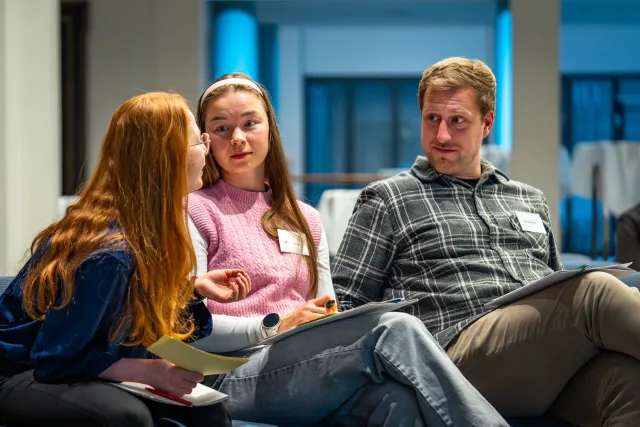
After the lunch break, discussions at Flensburg City Hall turn to concrete proposals. Around the tables, participants are tasked with developing policy recommendations. The “Strawberries,” the group at Milen Steensen’s table, quickly identify a problem area.
“There isn’t a proper pedestrian crossing at the bus station,” Steensen says. “You have to wait and then make a run for it. Then a bus comes around the corner, and you just have to hope you make it across safely.”
Someone suggests that the entire area may need to be redesigned.
“With a pedestrian bridge,” an older participant proposes.
“But would it be accessible?” Steensen counters.
“Oh, come on!” her fellow participant exclaims, throwing up his arms in a gesture of helplessness. Everyone laughs.
Guided by their facilitator, they eventually distil their discussion into three key challenges, recording them on cards before presenting them to the full assembly. With the help of experts from the city administration, they have also begun to develop possible solutions.
Lars Sonntag Calls It a Collective Achievement
Shortly after 5 p.m., the day comes to an end. Lars Sonntag is exhausted. “That was a lot of work,” he says. “I didn’t expect us to dive so deeply into the details.” While the facilitators pack up and a few participants linger in small groups, Sonntag is already on his way out. He gets into his Ford Kuga and drives home.
A month and a half later, the fourth and final session of the citizens’ assembly has concluded. The participants have formulated 29 recommendations, including one calling for a 30 km/h speed limit in the city centre. A proposal to close a major shopping street by the harbour to car traffic, however, failed to secure a majority. The next move now lies with the city council and administration. They will select those recommendations that are clearly formulated, specific, feasible and suitable for cost assessment. Eligible voters will then decide on this shortlist in a referendum on 18 April 2027.
A phone call with Lars Sonntag. How does he look back on the citizens’ assembly and its outcomes today?
“Well, I’ve just had to make my way through Flensburg’s construction-site chaos again,” he says with a laugh. But he is proud of what the group accomplished, describing it as a collective achievement. “There were different opinions, but we always managed to find common ground. Drivers’ perspectives were heard, too.” He says he has already heard criticism from people in his personal circle about the recommendation to introduce a 30 km/h speed limit. “But I’m happy to explain it to them, including my grown-up sons. If they want to drive faster, they can do so outside the city.”
Sonntag says the experience has also given him a greater appreciation of politicians, even if traffic conditions still frustrate him as a driver. “You should understand the reasons behind things before you start complaining, and I understand them much better now.” Above all, he takes two things away from the citizens’ assembly: the confidence that people are working towards good solutions and the realization that “there are a great many kind people in Flensburg, across all generations.”
![[DE Copy] Bürgerräte_800x600](/sites/default/files/styles/bosch_4d3_medium/public/images/media/2025-04/DBT_B%C3%BCrgerrat_800x600.png.webp?h=827069f2&itok=J4qgs5EZ)