Image
GPPI_Peace-Security-Aid-in-Crisis.png
Download PDF

Peace & Security Aid in Crisis

Peace & Security Aid in Crisis
2025
Peace & Security Aid in Crisis

While global political violence has almost doubled since 2020, President Trump’s destruction of USAID, the United States’ aid agency, accelerates and drastically worsens a sharp downward trend in non-military peace and security assistance among many donors. In 2025, as this study shows, we may see 34 percent less global investment in peace and security compared to the 2021-2023 average. This analysis shows how donors allocate money and power, and how not only investment in peace and security in general but also the commitment to locally-led peacebuilding in particular are deeply in crisis, and offers a way out.
The study was undertaken by Melissa Li, Maximilian Biller and Philipp Rotmann of the Global Public Policy Institute (GPPi) with financial support from the Robert Bosch Stiftung.

GPPi

Authors

Melissa Li, Maximilian Biller, Philipp Rotmann

Image
Cover_ParticipatoryApproaches_800x800
Download PDF

Participatory Approaches to Conflict, Climate Change and Environment

Bücher und Studien
2025
Participatory Approaches to Conflict, Climate Change and Environment

The Middle East and North Africa are one of the regions most affected by conflict worldwide. These conflicts result in massive environmental damage, while climate change and environmental degradation also give rise to new injustices and conflicts at the local level. Despite this, affected groups and stakeholders are often not involved in decision-making processes. This publication analyzes the implementation of participatory approaches in 7 countries in the region, particularly with regard to the potential for a better understanding of their implications for human security.
The dossier was produced in close collaboration with the Arab Reform Initiative.

Arab Reform Initiative & Robert Bosch Stiftung GmbH

Authors

Abdalftah Hamed Ali, Abeer Butmeh, Ahmed Alwadei, Asma Khalifa, Hussam Hussein, Sammy Kayed, Sarine Karajerjian, Shivan Fazil, Tobias Zumbraegel

Image
Rising Temperatures-Falling Resources
Download PDF

Rising Temperatures, Falling Resources

Rising Temperatures, Falling Resources

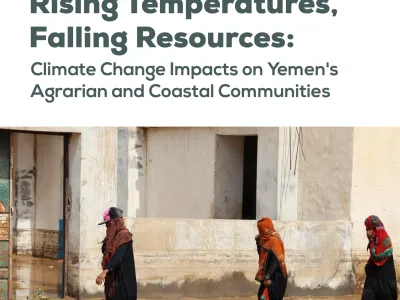
As the world continues to grapple with the effects of climate change, Yemen finds itself in a particularly vulnerable situation. The country is already facing several challenges, including an internationalized civil war and severe economic crisis. Climate change is likely to further exacerbate existing problems, with extreme weather events such as flash floods and droughts, as well as rising sea levels, already occurring in some parts of the country. This report focuses on two districts in Yemen which have been particularly affected by climate change and are likely to suffer further consequences in the future: Hajar district, Hadhramaut, and Tawahi district, Aden. Through a series of in-depth interviews and dialogues with local stakeholders, this report seeks to identify the direct and indirect impacts of climate change in the districts, as well as to highlight potential solutions and strategies for mitigation and adaptation.

Yemen Policy Center

Authors

Hadil Al-Mowafak

Image
2023-09-29_Berghof-CCE_Cover
Download PDF

Climate change effects on conflict dynamics in Iraq

Climate change effects on conflict dynamics in Iraq
2023
Climate change effects on conflict dynamics in Iraq

The negative effects of climate change and the security risks associated with it are beginning to register across Iraq. This study seeks to delve deeper into the issue of climate change and its links to and effects on conflict dynamics throughout the country. The report was published within the project “Supporting local dialogue to address climate security risks in Iraq”, supported by Robert Bosch Stiftung.

Peace Paradigms, Berghof Foundation
Image
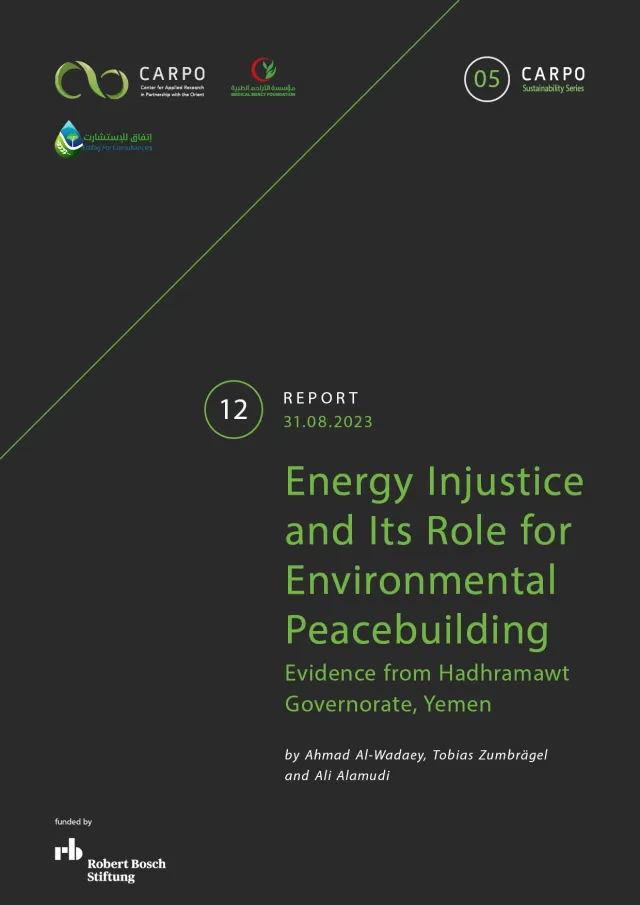
CarpoReport12
Download PDF

Carpo Report - Energy Injustice and its Role for Environmental Peacebuilding

Bücher und Studien
2023
Carpo Report - Energy Injustice and its Role for Environmental Peacebuilding

This Report discusses the crucial but understudied impact of oil extraction industries on local communities and the environment in Yemen’s Hadhramawt governorate. By combining conceptual approaches of energy justice and the environmental peacebuilding literature, it provides a novel perspective on how environmental pollution via the oil industry in Yemen creates injustices and grievances and might hamper sustainable peace efforts. The report was published within the framework of the Support Program “Conflict, Climate Change and Environment in the Middle East”, organized by Robert Bosch Stiftung.

CARPO
Authors

Ahmad Al-Wadaey, Tobias Zumbrägel, Ali Alamudi

Image
Innovative Practices
Download PDF

Innovative Practices

Bücher und Studien
2023
Innovative Practices

In a rapidly changing aid system, many donors, INGOs and local actors are increasingly seeking to integrate principles of local leadership into their work. Against this backdrop, Conducive Space for Peace (CSP) collected and analyzed a range of innovative practices that can contribute to changing the international system by ensuring local leadership. This learning note aims to provide a birds-eye view of a universe of innovations taking place within the wider field of peacebuilding and development, for individuals and organizations to be inspired, to reflect on and to learn from each other. Drawing on desk research and consultations with practitioners, it presents an overview of practices in the areas of Funding, Partnerships and Learning and Accountability. Additionally, an interactive map linked to this learning note offers INGOs, bilateral donors, and other relevant actors a space to share and further explore these experiences and innovations.
The publication is a part of the partnership between the Robert Bosch Stiftung and CSP. It was made possible by core funding provided to CSP. At the center of this collaboration is the effort to ensure local actors lead in peacebuilding efforts


Conducive Space for Peace