Image
[DE Copy] Agora Agrar land use study
Download PDF

Agriculture, forestry and food in a climate neutral EU

Programm- und Projektbroschüren
2024
Agriculture, forestry and food in a climate neutral EU

Approximately a third of all CO2 emissions come from our agricultural and food system. There is a lack of potential analyses and feasible future scenarios that take a holistic view on the land use sector. Our partner, the think tank Agora Agrar, is helping to fill this gap for the European Union with a new study.    
Based on scientific evidence and numerous discussions with stakeholders from academia, politics, administration and the agriculture, forestry, food and bio-economy sectors, the Agora Agrar team presents a sound and solution-oriented scenario with concrete proposals for policy measures.  

Agora Agrar

Authors

Agora Agriculture

Image
Cover Entwaldungsfrei produzieren
Download PDF

Deforestation-free production and keeping smallholders in supply chains

Programm- und Projektbroschüren
Entwaldungsfrei produzieren und dabei Kleinproduzent*innen in Lieferketten halten

The EU regulation for deforestation-free products (EUDR) starting from December 30, 2024, has implications for small-scale producers in supply chains. In a new policy paper by Germanwatch e.V., Katharina Brandt, Matilda Franz, and Pia Enders provide recommendations on how the EU and companies can support small-scale producers to produce deforestation-free while ensuring their livelihoods. The focus is on implementing higher sustainability standards and traceability in supply chains to prevent deforestation and protect small-scale producers.

Germanwatch e.V.

Authors

Katharina Brandt, Matilda Franz, Pia Enders

Image
[DE Copy] ecologic_Abschlussbericht_Cover
Download PDF

Towards climate friendly and resilient agri-food systems in Central Eastern Europe

Programm- und Projektbroschüren
2024
Auf dem Weg zu klimafreundlichen und widerstandsfähigen Agrar- und Ernährungssystemen in Mittelosteuropa

Agriculture in the EU is responsible for around 13% of greenhouse gas emissions. Agriculture and food consumption are the biggest contributors to biodiversity loss, environmental degradation and diet-related diseases. This report is intended to serve as an inspiration and framework for stakeholders in Central and Eastern European Countries (CEECs) to develop a more holistic and coordinated approach to the transition to climate-friendly and resilient agricultural and food systems.

Auf dem Weg zu klimafreundlichen und widerstandsfähigen Agrar- und Ernährungssystemen in Mittelosteuropa

Authors

Ana Frelih Larsen and others

Image
[DE Copy] Meeting-skills_Publikation_600x800
Download PDF

Meeting Skill Needs for the Global Green Transition

Meeting Skill Needs for the Global Green Transition

The green transition is not just about expanding sustainability, it also creates an enormous demand for skilled workers. In this policy paper, Sam Huckstep and Helen Dempster examine the demand and supply dynamics of skills crucial to the green transition in both the Global South and North. Focusing on the installation and maintenance workforce in solar photovoltaic panels and heat pumps, their findings reveal a critical shortage of skilled workers in almost all ten countries studied. Particularly challenging is the scenario in the Global North, compelled to accelerate emission cuts amidst aging populations. To meet green transition targets, migration emerges as a vital complement to local training and reskilling efforts. While the global shortage of green-skilled workers must be recognized, the authors emphasize that such a skills-based migration strategy must be coupled with robust support for training and retaining talents locally. 

Center for Global Development

Authors

Sam Huckstep, Helen Dempster

Image
Rising Temperatures-Falling Resources
Download PDF

Rising Temperatures, Falling Resources

Rising Temperatures, Falling Resources

As the world continues to grapple with the effects of climate change, Yemen finds itself in a particularly vulnerable situation. The country is already facing several challenges, including an internationalized civil war and severe economic crisis. Climate change is likely to further exacerbate existing problems, with extreme weather events such as flash floods and droughts, as well as rising sea levels, already occurring in some parts of the country. This report focuses on two districts in Yemen which have been particularly affected by climate change and are likely to suffer further consequences in the future: Hajar district, Hadhramaut, and Tawahi district, Aden. Through a series of in-depth interviews and dialogues with local stakeholders, this report seeks to identify the direct and indirect impacts of climate change in the districts, as well as to highlight potential solutions and strategies for mitigation and adaptation.

Yemen Policy Center

Authors

Hadil Al-Mowafak

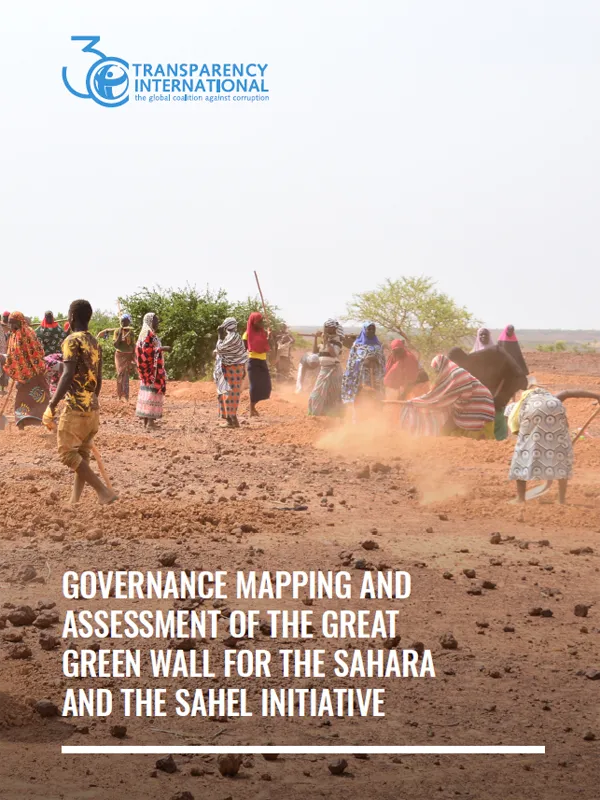
Governance Mapping and Assessment of the Great Green Wall for the Sahara and the Sahel Initiative

Governance Mapping and Assessment of the Great Green Wall for the Sahara and the Sahel Initiative
2023
Governance Mapping and Assessment of the Great Green Wall for the Sahara and the Sahel Initiative

The Great Green Wall for the Sahara and the Sahel Initiative (GGWI) was launched by the African Union in 2007 to build a sustainable future across the vast Sahel region. By 2030, the initiative aims to restore 100 million hectares of degraded land, preserve fertile land for agriculture and strengthen resilience to climate change.

To realise it’s ambitions, however, it must be vigilant about good governance to ensure that resources are used efficiently, transparently and accountably and that policies and projects are designed to benefit the people and environment it should serve. Our partner Transparency International analyses the GGWI in three critical areas: transparency, participation, and accountability and integrity. The report, supported by the Robert Bosch Foundation, focuses on the Pan African Agency of the Great Green Wall and its 11 member states, with a particular focus on Niger and Senegal.

Transparency International

Climate Change and Migration

Klimamigration
2023
Klimamigration

This policy paper provides a comprehensive and up-to-date overview of the challenges and potential policy options concerning climate-related migration. Climate change will have a significant impact on migration movements at all levels, including national, regional, and international level. In many cases, they are already becoming apparent. While most migration movements affected by climate change will occur within national borders, the international system is inadequately prepared for the changes and migration movements that are to come. Migration is an effective means of adapting to climate change. Yet, political measures are necessary to support the positive impacts and opportunities of climate-related mobility while mitigating any negative consequences. The authors of this publication present concrete policy options in this context.

Center for Global Development

Authors

Sam Huckstep, Michael Clemens

Research on Sustainable Land Use and Rights for Climate Adaptation and Resilience among Marginal Communities in Kenya and Tanzania

Bücher und Studien
2022
Research on Sustainable Land Use and Rights for Climate Adaptation and Resilience among Marginal Communities in Kenya and Tanzania

This report presents the findings of a study conducted in Kenya and Tanzania. It consolidates communities’ and stakeholders’ views on and perceptions of structural barriers that hinder communities’ effective participation in international debates on sustainable land use and rights and climate adaptation and hence resilience.
The study is part of a project with Power Shift Africa on effective African leadership in sustainable land use and rights for climate resilience.


Robert Bosch Stiftung

Authors

Mohamed Adow, Emmanuel Siakilo

Policy Brief: Land Use, Land Rights and Climate Adaptation and Resilience

Policy Brief: Land Use, Land Rights and Climate Adaptation and Resilience
2022
Policy Brief: Land Use, Land Rights and Climate Adaptation and Resilience

This policy brief presents the key findings of a study supported by the Robert Bosch Stiftung and conducted by Power Shift
Africa in Kenya and Tanzania on structural barriers that hinder communities’ effective participation in key adaptation and resilience
discourses at regional and international level.

Robert Bosch Stiftung
Image
DGAP Policy Brief Teaserbild 600x800
Download PDF

Migration in the Context of Climate Foreign Policy

Die Rolle von Migration in der Klimaaußenpolitik

Migration, displacement and planned relocation in the context of climate change are no longer distant future scenarios. Climate-related migration is already a reality. Global warming of at least 1.5°C will cause more people to migrate in the coming decades, especially within particularly affected countries and regions. Should the earth warm even more, numerous areas, some of which are densely populated today, would become uninhabitable.The policy brief of the German Council on Foreign Relations puts the issue in context and proposes concrete development and foreign policy measures that the German government should take into account in its planned strategy on climate roreign rolicy.

Deutsche Gesellschaft für Auswärtige Politik e.V.

Authors

Dr. Kira Vinke, Hannes Einsporn, Dr. Dana Schirwon, Mahalia Thomas